CapitalUnited States
Where the AI money goes: a venture map from power plants to apps

TypeSafe AI, the developer of a model called Jev, has raised $870 million in a Series A at a $7.5 billion valuation. Andreessen Horowitz led the round, which the firm announced on Oct. 9, with Sequoia Capital and existing investor DCVC taking part. The same day Oxide Computer, which builds rack-scale cloud computers that companies own and run in their own data centers, announced a $445 million Series D led by Eclipse. Existing investors joined, and so did two newcomers, Atreides Management and AMD Ventures.
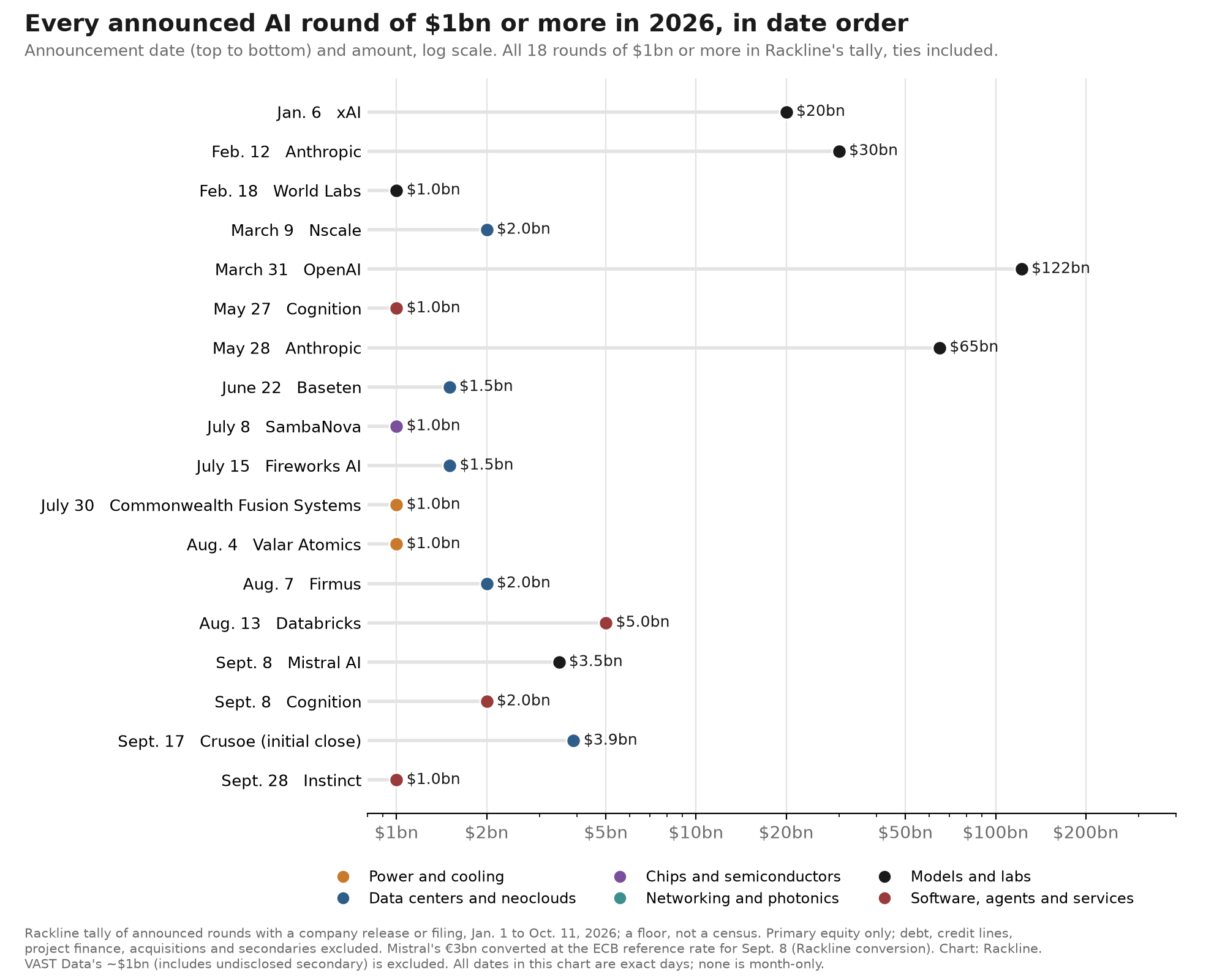
Only one round announced in the past two weeks was bigger: on Sept. 28 Instinct, which is building a personal AI agent, said it had raised a $1 billion Series C at a $10 billion valuation from Sequoia Capital, Benchmark and Coatue. TypeSafe and Oxide sum up how the market has changed. One is a software bet on a model so new that its funding round is still labeled A. The other is a hardware company asking investors to pay for metal. Around them, the past fortnight brought money for every layer beneath an AI model. Voltus, which pays businesses and battery owners to flex their power use, raised $225 million on Oct. 8. The same day VEIR, which makes superconducting power lines for data centers, raised $110 million. On Sept. 30 GMI Cloud announced $223 million of equity for its GPU cloud alongside a separate $445 million credit facility, and CScale emerged from stealth with $145 million for optical links between chips.
For bankers, the pattern matters more than any single deal. Venture capital has moved down the stack, out of pure software and into the physical inputs AI consumes: chips, the networks that tie them together, the buildings that house them and the power that feeds them. At the same time, the frontier labs have raised sums that make the word "venture" hard to use with a straight face. Those two shifts are changing who writes the checks, what the checks buy and how investors expect to be repaid. This guide rests on Rackline's own tally of announced rounds, built from company releases, lead investors' posts and securities filings for Jan. 1 through Oct. 11, 2026. The tally is a floor, not a census. It counts only rounds announced with a company release or filing, and only primary capital that was raised or firmly committed. Debt, credit lines, secondary share sales, carve-outs and acquisitions are excluded, as are rounds reported only in the press. On that basis the tally holds 118 rounds totaling $287.9 billion. Five lab rounds, at OpenAI, Anthropic (twice), xAI and Mistral AI, account for $240.5 billion of it, or 84%. Strip out the model and lab layer entirely and the remaining 106 rounds come to $44.4 billion.
The simplest way to read the AI market is as a stack of six layers, each selling to the one above it. At the bottom is power and cooling: generation, from fusion and fission to gas turbines placed beside data centers; grid-flexibility services; and the equipment that moves electricity and heat inside a facility. Its buyers are utilities, data-center developers and the hyperscale cloud companies. Above it sit data centers and neoclouds. This layer includes developers of so-called AI factories and the specialized GPU and inference clouds that rent capacity by the hour or by the token. It also takes in storage and training platforms, and on-premises cloud hardware such as Oxide's. Its customers are the model labs, enterprises and software companies. The chips layer covers accelerators, inference processors, edge AI chips and the equipment used to make and inspect them. Networking and photonics connects those chips: switch silicon, Ethernet fabrics, and the optical and chiplet interconnects that let thousands of processors behave as one machine. Both sell to the cloud operators and, increasingly, to the labs directly.
The models and labs layer trains the systems themselves and sells access to them, chiefly by the token. At the top, software, agents and services turns those models into products that businesses buy: data platforms, coding agents, customer-service agents, security tools, voice and generative media.
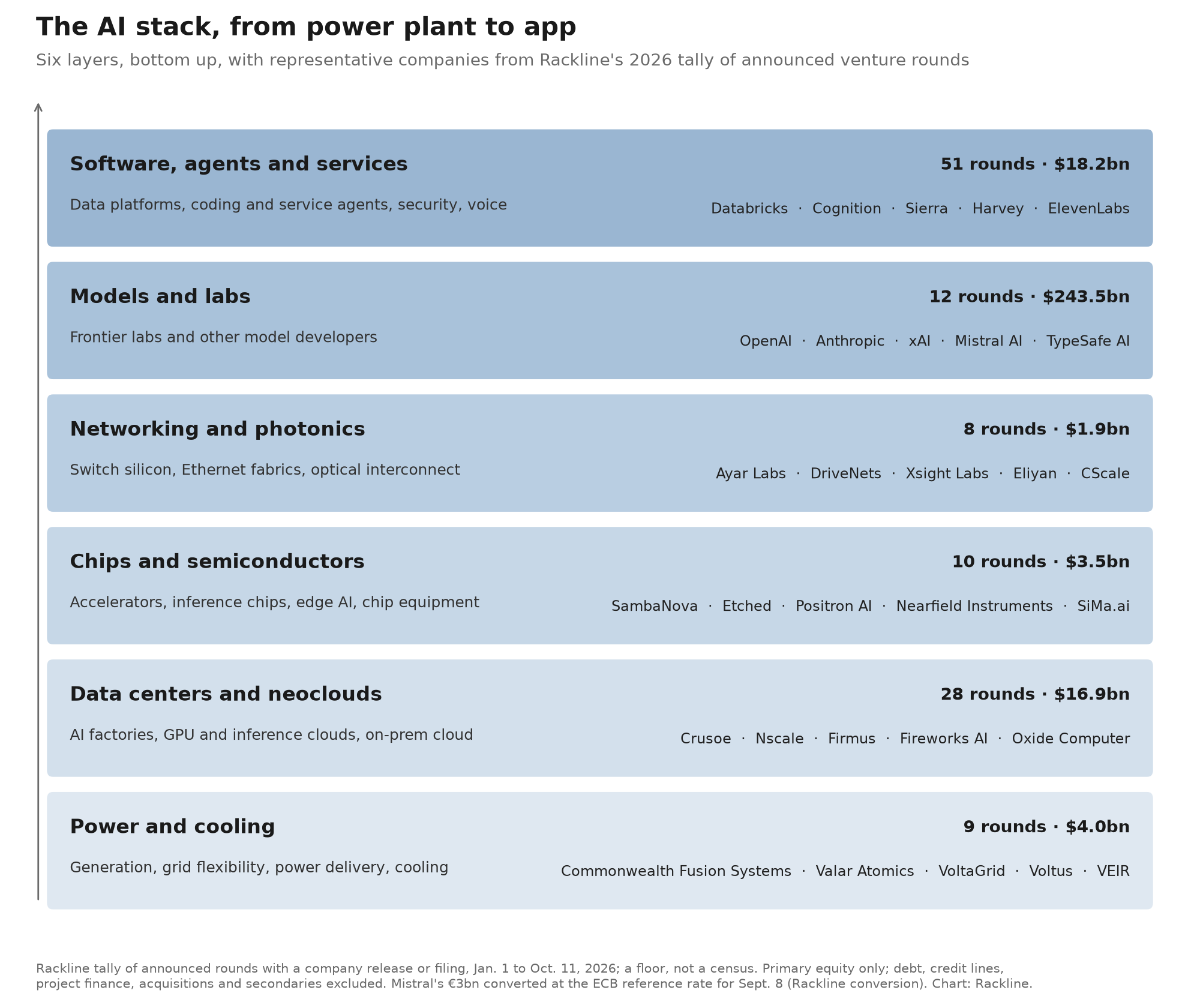
Money flows down the stack as well as up. A software company's revenue becomes a lab's API income. That becomes a cloud contract, which becomes an order for chips and a request for a grid connection. Investors who fund one layer are, in effect, making a call on the layers below it.
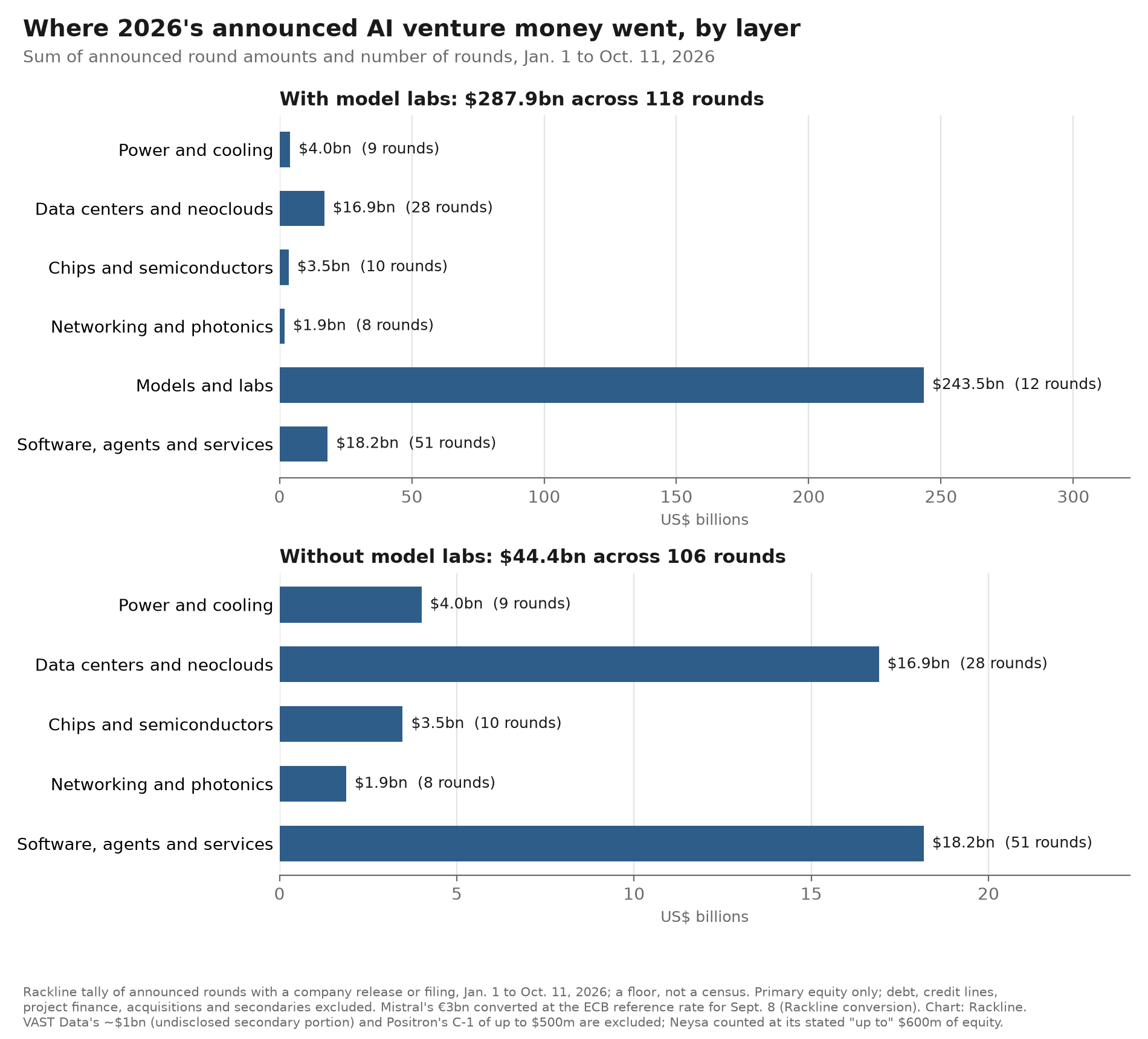
Rackline's companion guide, "The AI model business, explained," covers what the labs build and sell. The question here is narrower: how their fundraising distorts the venture picture. The model and lab layer holds 12 rounds worth $243.5 billion. OpenAI closed $122 billion of committed capital on March 31 at an $852 billion post-money valuation, completing a raise it had announced on Feb. 27. That earlier announcement included $30 billion from SoftBank, $30 billion from Nvidia and $50 billion from Amazon. Amazon's own filing shows how a commitment becomes cash. Its quarterly report for the period ended June 30 says it carried a "$28.7 billion investment in Series C Preferred Stock" at that date. It adds: "Subsequent to June 30, 2026, we funded the remaining Commitment Amount of $21.3 billion." That completes the $50 billion.
Anthropic raised a $30 billion Series G in February at $380 billion and a $65 billion Series H in May at $965 billion. The Series H included $15 billion of previously committed hyperscaler money and brought in Micron, Samsung and SK hynix as what Anthropic called "strategic infrastructure partners." xAI raised $20 billion in January with Nvidia and Cisco Investments as strategic investors. Mistral AI raised €3 billion in September at a post-money valuation of more than €21 billion, led by Samsung Electronics, with Nvidia and ASML among those taking part. Two features stand out. First, the checks increasingly come from the labs' suppliers: chipmakers, memory makers and cloud providers whose sales depend on the labs' spending. Second, below the frontier the layer looks more like conventional venture, exits included. The seven other model-developer rounds in the tally total about $3 billion. Besides TypeSafe's $870 million, World Labs raised $1 billion in February; on Sept. 28 AMD agreed to buy it for about $8.2 billion in stock, subject to regulatory approval. General Intuition raised a $320 million Series A at $2.3 billion, Odyssey a $310 million Series B, Sarvam AI a $234 million first close at $1.5 billion, Goodfire $150 million at $1.25 billion and TwelveLabs $100 million. The median round in the layer is $935 million, against $130 million in software.
The chips layer drew 10 rounds and $3.5 billion, and networking and photonics eight rounds and $1.9 billion. Small next to the labs, those sums are still large checks for companies that have yet to ship chips in volume.
The biggest checks went to companies building chips for inference, the work of running trained models. SambaNova announced a $1 billion first close on July 8 at an $11 billion post-money valuation, led by General Atlantic. Etched raised twice in four weeks. On July 23 it said it had raised $300 million at a $10.3 billion valuation, led by Sequoia Capital. On Aug. 18 it raised $700 million at $21 billion in a round "led by Jane Street," in the same post that reported its first rack delivery to the trading firm: a customer turned lead investor, at about twice the July valuation. Positron AI announced on Sept. 10 a $375 million Series C at a $3.5 billion pre-money valuation, co-led by NEA, Andra Capital, Atreides Management, Valor Equity Partners and SemiAnalysis Capital. It also announced a Series C-1 of up to $500 million, led by NEA and Jim Clark, and a combined post-money valuation of $5 billion. Rackline counts only the $375 million, because the C-1 is stated as a ceiling. Positron had already raised a $230 million Series B in February. SiMa.ai, which makes edge chips, raised $150 million on Sept. 28 at $1.45 billion, co-led by Fidelity Management & Research and Amplify Partners. Further back in the supply chain, Nearfield Instruments raised $380 million for semiconductor metrology equipment at a $1.6 billion valuation, with Fidelity among the new investors.
Networking money followed the shift to ever-larger clusters, where the links between chips limit performance as much as the chips do. Ayar Labs closed a $500 million Series E for co-packaged optics at $3.75 billion, led by Neuberger Berman. DriveNets raised $410 million for Ethernet fabrics, led by Bessemer Venture Partners and Atreides, and Xsight Labs raised more than $300 million at $2.8 billion, led by Fidelity. Eliyan raised $145 million at $1 billion, led by Seligman Ventures, with Cisco Investments and Lumentum as new strategic investors. CScale's $145 million Series C was led by Atreides with Valor Equity Partners, with Premji Invest as co-lead, and brought in Nvidia and Intel Capital as its first strategic investors.
The incumbents, meanwhile, have bought rather than waited. Qualcomm completed its purchase of Modular, a developer of AI software tools, on July 28, mainly for Qualcomm shares. Its quarterly filing says the deal "values Modular at approximately $3.1 billion," roughly twice the $1.6 billion valuation Modular announced in September 2025. Microchip Technology closed its purchase of Hailo on Sept. 21, Infineon closed C2i Semiconductors on Oct. 5 and Navitas closed Claros on Oct. 6, and AMD agreed on Aug. 6 to buy Taalas, subject to regulatory approval. None of those four disclosed a price. For a chip startup, a strategic sale is a live alternative to the public markets, and the acquirers are paying for teams and designs rather than revenue.
The four physical layers together took most of the money outside the labs: $26.3 billion, or 59% of the ex-lab total. Data centers and neoclouds drew 28 rounds and $16.9 billion, or 38%. Power and cooling drew nine rounds and $4.0 billion.
Crusoe announced on Sept. 17 the initial closing of an "anticipated" $3.9 billion Series F at a $30.9 billion post-money valuation, co-led by Atreides, Mubadala Capital and Valor. Rackline counts the $3.9 billion as announced and labels it an initial close. Nscale raised $2 billion in March at $14.6 billion, led by Aker and 8090 Industries. Firmus, an Australian builder of Nvidia-based AI factories, raised $2 billion of strategic equity at a post-money valuation above $10.5 billion from investors including Coatue, Nvidia, Blackstone and Jane Street. Fireworks AI raised $1.5 billion at $17.5 billion, and Baseten raised twice, $300 million in January and $1.5 billion in June at $13 billion. PaleBlueDot AI also came back within the year: $150 million in January at more than $1 billion, then $200 million on Oct. 1 at $3.2 billion. Groq, now running its own inference cloud, raised $650 million in June and a $350 million Series A for Groq LLC in August at $3.5 billion, led by Disruptive with planned participation from Nvidia and subject to closing conditions. Blackstone's release on Neysa, an Indian AI cloud, says investors signed definitive agreements to provide equity "of up to $600 million," which Rackline counts with that caveat. VAST Data's Series F at a $30 billion valuation is left out, because the company said the roughly $1 billion transaction "included primary and secondary capital" without giving the split.
In power and cooling, the money went to generation that might arrive in time for the next wave of data centers, and to tools that squeeze more out of the existing grid. Commonwealth Fusion Systems raised another $1 billion in July, bringing its total to $4 billion. Valar Atomics raised a $1 billion Series B for small reactors, led by Sequoia Capital, and Helion Energy's Series G reached a final $500 million, at a $15.5 billion post-money valuation stated at its initial close. VoltaGrid, which supplies gas turbines placed beside data centers, signed a $1 billion strategic equity deal with Blackstone and Halliburton, of which $775 million was primary capital. Emerald AI, whose software lets data centers flex their demand, raised $150 million at $1.05 billion. Voltus said its Series D would help it reach 20 gigawatts of flexible capacity by 2030, and Accelsius, a liquid-cooling company, raised $65 million in a round led by Johnson Controls.
Beside this equity sits a growing pile of debt, which Rackline keeps out of its venture totals. GMI Cloud's $445 million credit facility, led by CTBC, came alongside its equity, and Valar Atomics closed a $200 million credit facility led by Erebor Bank and J.P. Morgan alongside its Series B. Neysa said it intends to raise $600 million of debt on the back of its equity, subject to documentation. OpenAI expanded its revolving credit facility to about $4.7 billion, undrawn at the March close, and Cerebras' prospectus shows OpenAI advancing it a working-capital loan of about $1 billion, repayable "in cash or through the delivery of compute capacity." The biggest suppliers are underwriting capacity directly, too. Nvidia's quarterly report says it has guaranteed, up to a cap of $105 billion, OpenAI's leases at SB Energy's campus in Pike County, Ohio. The same filing puts its cloud-service commitments to AI cloud partners at $36 billion, and says it signed memorandums with capital providers in August aiming to mobilize "more than $500 billion of third-party capital" for AI infrastructure.
Carve-outs and buyouts sit outside the tally as well. Flex agreed on Oct. 5 to sell $2.0 billion of convertible preferred stock in Axiom, its cloud and power unit, to General Catalyst, Koch Equity Development and co-investors at an initial enterprise value of $37.5 billion. The preferred pays a 10% cash dividend until Flex spins Axiom off, which it plans to do in the first quarter of 2027. AIP, MGX and BlackRock's Global Infrastructure Partners closed their purchase of Aligned Data Centers on July 21 at an enterprise value of about $40 billion, and committed another $5 billion of growth capital at closing. The capacity layer is where venture, private credit and infrastructure finance now meet. Equity rounds are increasingly the first slice of a capital stack that is mostly debt.
The software layer has the most deals and, as a single layer, the most money outside the labs: 51 rounds worth $18.2 billion, 41% of the ex-lab total. Its median round of $140 million is smaller than in any other layer. The median is $175 million in networking, $225 million in power, about $260 million in data centers and $275 million in chips. The physical layers absorb the bigger checks; software's weight comes from volume.
A few software rounds were big enough to compete for attention with infrastructure. Databricks closed $5 billion of strategic funding on Aug. 13 at a $190 billion valuation, led by Coatue, and said in the same release that its revenue run rate had passed $7 billion. Cognition, which builds coding agents, raised more than $1 billion at $26 billion in May, then more than $2 billion at $48 billion in a Series E announced Sept. 8, led by Andreessen Horowitz and Accel. Instinct's $1 billion came three weeks later. Sierra, a customer-service agent company, said in May it was raising $950 million at more than $15 billion, led by Tiger Global and GV. Harvey, which sells AI to lawyers, raised $200 million in March at $11 billion and $550 million in September at $15.5 billion. Cyera, a security company, raised $400 million in January at $9 billion and $600 million in June at $12 billion. In voice and media, ElevenLabs raised $500 million at $11 billion, led by Sequoia, and Higgsfield raised $400 million at $5.4 billion for generative video. Arena, which runs evaluations of AI models, raised a $150 million Series A in January led by Felicis and UC Investments, then $200 million on Oct. 8 at $3.1 billion, co-led by Lightspeed Venture Partners and Khosla Ventures.
Several software companies raised twice within months, at higher prices each time. That points to investors paying for revenue growth that the companies now disclose, as Databricks did. It also leaves the layer exposed if model providers move further into applications.
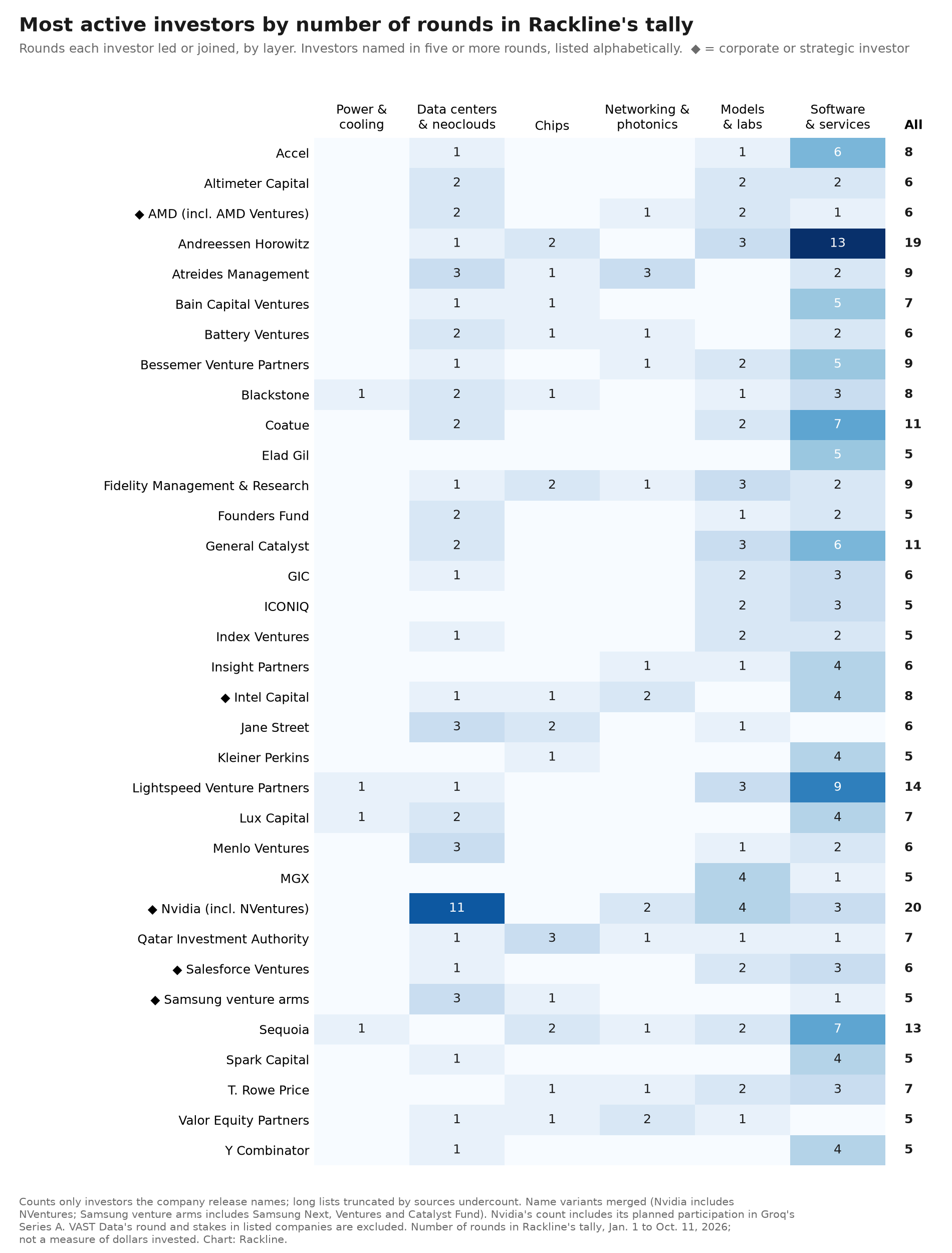
Counted by rounds rather than dollars, the most active investors in Rackline's tally fall into two groups: suppliers and specialists. Nvidia, including its NVentures arm, appears in 20 rounds, 11 of them in data centers and neoclouds, and led none. That pattern fits a supplier seeding its own customers. Andreessen Horowitz appears in 19 rounds, 13 of them in software, and led five. Lightspeed Venture Partners appears in 14 and Sequoia in 13, five of which it led. Coatue and General Catalyst appear in 11 each. Atreides Management appears in nine rounds and led or co-led five, all in chips, networking and data centers. Bessemer and Fidelity Management & Research appear in nine each, and Accel, Blackstone and Intel Capital in eight.
The corporate investors' filings show how large those stakes have become. Amazon's equity investments in private companies outside the equity method, chiefly Anthropic and OpenAI preferred stock, were carried at $122.3 billion at June 30, up from $16.2 billion at the end of 2025. Upward adjustments "primarily from our nonvoting preferred stock in Anthropic" came to $62.8 billion in the first half. Nvidia's non-marketable equity securities stood at $47.9 billion at the end of its July quarter, up from $22.3 billion at the start of its fiscal year, and the company says it holds "equity investments of $99 billion and equity investment commitments of $25 billion." Microsoft reports an approximately 25% stake in OpenAI and $13.0 billion of total funding commitments, of which $11.9 billion was funded by June 30. Alphabet carried $131.5 billion of non-marketable securities at June 30. It says the bulk of them, $124.3 billion carried at cost adjusted for observable price changes, "primarily consist of our investment in a private company" that it does not name.
Some of the largest strategic checks went to listed companies, and Rackline keeps them out of the venture tally. Nvidia bought $2 billion of CoreWeave stock on Jan. 23, put $2 billion each into Lumentum and Coherent on March 2 alongside optics purchase commitments, invested $2 billion in Nebius through a pre-funded warrant on March 11 and bought $3.5 billion of MediaTek convertible bonds on Aug. 31. Elsewhere, strategic investors joined venture rounds as co-investors. AMD Ventures co-led TensorWave's $350 million Series B at $1.55 billion. Intel Capital, Qualcomm Ventures, Nvidia and AMD Ventures all joined Hark's Series A of more than $700 million at a $6 billion valuation, and Cisco Investments took part in rounds at xAI, Eliyan and Positron. Some deals return the money to the investor as orders. OpenAI's capacity agreement with Cerebras came with a warrant on up to 33,445,026 Cerebras shares, most of which vest as compute capacity is delivered. Anthropic's commitment to spend more than $100 billion on Amazon Web Services over 10 years came in the same announcement as a $5 billion Amazon investment. When the investor is also the supplier, a valuation mark and a sales contract can be two sides of one transaction. Bankers pricing these companies should read them that way.
Public markets have begun to price the stack, unevenly. SpaceX, which acquired xAI in February, priced its IPO on June 11, selling 555,555,555 Class A shares at $135 for $75.0 billion. On Rackline's calculation from the prospectus, the company was worth about $1.77 trillion at the offering price, and its shares closed at $156.54 on Oct. 13. Cerebras Systems priced 30 million shares at $185 on May 13, raising $5.55 billion, a value of about $39.8 billion on Rackline's calculation; it closed at $149.09 on Oct. 13. Fervo Energy priced its IPO at $27 on May 12 and closed on Oct. 13 at $11.98; X-energy, the nuclear developer, priced at $23 on April 23 and closed at $12.72. The split matters for the power companies now raising private money. Their nearest public comparables trade at 44% and 55% of their offering prices, while Cerebras sits 19% below its offering price and SpaceX 16% above. On the private side, the clearest marks sit on corporate balance sheets rather than in exits. Alphabet recorded second-quarter gains of $99.0 billion on equity securities, "primarily related to unrealized gains in our equity securities portfolio from SpaceX and a private company." Amazon's Anthropic markups tracked Anthropic's valuation from $380 billion in February to $965 billion in May. Those marks are set by the next round, often one the same corporate investor joins.
Lockup expiries will test the newly listed names this fall. Up to about 19.4 million Cerebras shares become eligible for early release on each of Oct. 14 and Oct. 28, and the main Cerebras lockup ends by Nov. 9. X-energy's 180-day lockup ends on Oct. 20, subject to early-release terms in its prospectus. On Oct. 24, up to a further 7% of locked SpaceX shares become transferable, with another 28% following after its third-quarter results and the rest on Dec. 8. Microsoft reports fiscal first-quarter results on Oct. 28, its first quarterly report since the annual filing that put its OpenAI stake at about 25%. AMD reports third-quarter results on Nov. 3. The warrants it issued to OpenAI and Meta, each for up to 160 million AMD shares, had not vested as of June 27; any vesting would show up there. Several announced deals have yet to close. AMD's purchases of Taalas and World Labs await regulatory approval, and Flex's Axiom placement is pending. Crusoe has not said when its Series F will reach a final close, and Positron has not said how much of its Series C-1 it has drawn. Each will change the numbers above when it lands, which is the point of reading Rackline's tally as a floor.
Top image: Rows of cabinets in the Frontier exascale supercomputer at Oak Ridge National Laboratory in Oak Ridge, Tenn., in 2022. The system uses AMD Instinct GPUs. Photo: OLCF at ORNL / Wikimedia Commons, CC BY 2.0.