Chips & SupplyUnited States
Teradyne Brings Burn-In Testing to Titan HP for High-Power AI Chips
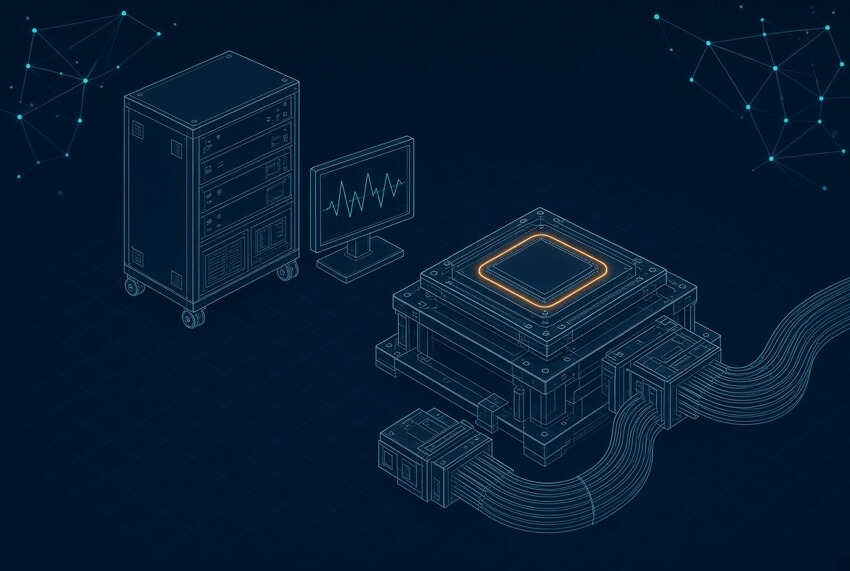
Teradyne has added enhanced burn-in capabilities to its Titan HP system-level test platform, targeting increasingly power-dense AI accelerators, cloud infrastructure processors and other high-reliability semiconductor devices. The production-ready system replaces the conventional model of stressing groups of chips inside temperature-controlled burn-in ovens with an approach that maintains each device at its target junction temperature while running realistic workloads.
The approach combines reliability stress and system-level testing on the same Titan HP platform. Teradyne says per-site thermal control can be tuned to the thermal and mechanical characteristics of individual devices, while high per-device kilowatt power delivery enables the system to test chips whose power consumption and heat dissipation are becoming difficult to accommodate using conventional burn-in flows. Each device can also retain its complete stress-and-test history in a single record.
Titan HP uses an asynchronous slot architecture, allowing each test site to load and operate independently. A long reliability test on one device therefore does not require other devices to wait for the same test cycle to complete, while individual sites can be serviced without stopping the entire system. Test programs run on Teradyne’s Atlas software platform and can be imported, newly created or ported across compatible Teradyne SLT systems. Teradyne says Titan HP with enhanced burn-in is available now and deployed in production.
Target Devices — High-power AI accelerators, cloud infrastructure silicon, automotive and other high-reliability devices
Burn-In Model — Runs realistic workloads while maintaining each device at its target junction temperature
Thermal Control — Per-site thermal control tailored to individual device thermal and force zones
Power — Kilowatt-class per-device power delivery, with a roadmap for higher future AI accelerator requirements
Architecture — Asynchronous slots allow devices to load and test independently and individual sites to be serviced while the system continues operating
Software — Teradyne Atlas for creating, importing and porting SLT programs
Availability — Available now and deployed in production
“Our customers are being asked to ship high-power AI silicon at reliability levels that used to belong to automotive,” said Jason Zee, vice president and general manager of Teradyne’s Integrated Systems Test division. Zee said moving reliability stress onto a system-level test platform can reduce test cost, improve time to market and provide better data on individual devices.
🌐 Analysis: AI Is Changing the Semiconductor Test Flow
Teradyne’s addition of burn-in to Titan HP reflects how AI accelerators are changing semiconductor reliability testing. Large AI devices increasingly combine high-power compute, HBM, chiplets and 2.5D/3D packaging, creating thermal and system-level failure modes that may not appear during conventional electrical testing. Instead of placing batches of devices in a common temperature-controlled oven, Titan HP can stress individual devices under realistic workloads while controlling their junction temperature. This brings reliability testing closer to actual operating conditions and applies reliability practices historically associated with automotive silicon to increasingly expensive AI accelerators.
The broader significance is the convergence of semiconductor test stages as AI devices become more complex and costly. Teradyne is positioning system-level test as a complement to wafer probe and package test, while integrating reliability stress onto the same platform could reduce dependence on separate burn-in equipment and provide a continuous device-level test history. Titan HP also fits Teradyne’s broader expansion across high-power AI chip testing, PCIe 6, silicon photonics/CPO and high-speed interconnect validation. As AI packages move toward kilowatt-class power envelopes, testing their electrical, thermal and functional behavior under realistic workloads is becoming a larger part of the manufacturing challenge.
Core Business — Automated semiconductor and electronics test equipment plus advanced robotics
AI Test Portfolio — UltraFLEXplus • Titan HP • Magnum • Photon 100 • MultiLane Test Products • Quantifi Photonics
Titan HP — High-performance system-level testing and reliability stress for high-power AI and cloud infrastructure devices
Strategic Direction — Extend test coverage across the AI device lifecycle from semiconductor manufacturing through increasingly system-level electrical, optical and reliability validation.
September 22, 2026 · OPTICAL NETWORKING / AI INFRASTRUCTURE ECOC: Teradyne Brings Semiconductor-Grade Test to MicroLEDs Iris 100 extends Teradyne’s production-test strategy into per-emitter microLED characterization for emerging AI optical interconnects.
September 1, 2026 · AI INFRASTRUCTURE Teradyne Expands UltraFLEXplus for PCIe 6 and High-Power Chip Testing New digital, PCIe 6 and high-current instruments address escalating data, interface and power requirements in AI semiconductor production test.
April 16, 2026 · SEMICONDUCTORS / TEST Teradyne Acquires TestInsight to Streamline Design-to-Test Workflow for Chips The acquisition adds pattern conversion, validation and virtual-test software intended to shorten design-to-production test cycles.
March 19, 2026 · CPO / OPTICAL TEST Teradyne Intros Automated Test Platform for SiPho and CPO Photon 100 combines electrical and optical instrumentation for high-volume testing of silicon photonics, optical engines and co-packaged optics.
February 1, 2026 · TEST & MEASUREMENT Teradyne and MultiLane Form JV for High-Speed Test for AI Data Centers MultiLane Test Products extends Teradyne’s reach into high-speed interconnect validation across silicon, modules and AI data center systems.