Power & SitesUnited States
Bloom Energy makes its case that AI data centers should run on direct current from the start
Electricity reaches big buildings as alternating current, but chips run on direct current. Bloom Energy is betting that the next generation of AI facilities will stop converting back and forth, and that its fuel cells are built for the switch.
The San Jose, Calif., company laid out the engineering case in a public technical white paper dated September 2026, "Leveraging Bloom Fuel Cells' Native 800 VDC Output for Data Center DC Power." It followed a Sept. 16 special report, "The New Rules of AI Power," which put a price on it.
At a conventional site, grid power arrives as AC, is stepped down, conditioned by uninterruptible power supplies and, as the paper puts it, "ultimately converted back to DC within every server." Each stage, Bloom says, "introduces losses, additional equipment, maintenance requirements, and potential failure points."
The pressure to change is coming from the chips. Nvidia said in May 2025 that it is leading a move to 800-volt DC to support racks of a megawatt or more starting in 2027, timed to its Kyber rack systems. Nvidia says the switch cuts copper needs by 45% compared with 415-volt AC and improves end-to-end efficiency by up to 5% over today's 54-volt rack systems.
Bloom's solid oxide fuel cells make electricity through an electrochemical reaction rather than a spinning generator, so their output is DC to begin with. "Rather than converting DC to AC and then back to DC before it reaches the computing equipment, a native DC architecture seeks to preserve DC power through as much of the electrical distribution system as practical," the paper says.
In Bloom's design, each fuel cell module has its own DC-to-DC converter, which holds the bus at a regulated 800 volts rail to rail, or plus and minus 400 volts around a grounded midpoint, while the cell's own voltage falls as load rises. Bloom puts the converters' efficiency at 98% to 99%. Modules of about 65 kilowatts roll up into 3.25 MW blocks it calls stamps, and because DC sources need not synchronize frequency and phase, more can be added to a shared bus as demand grows.
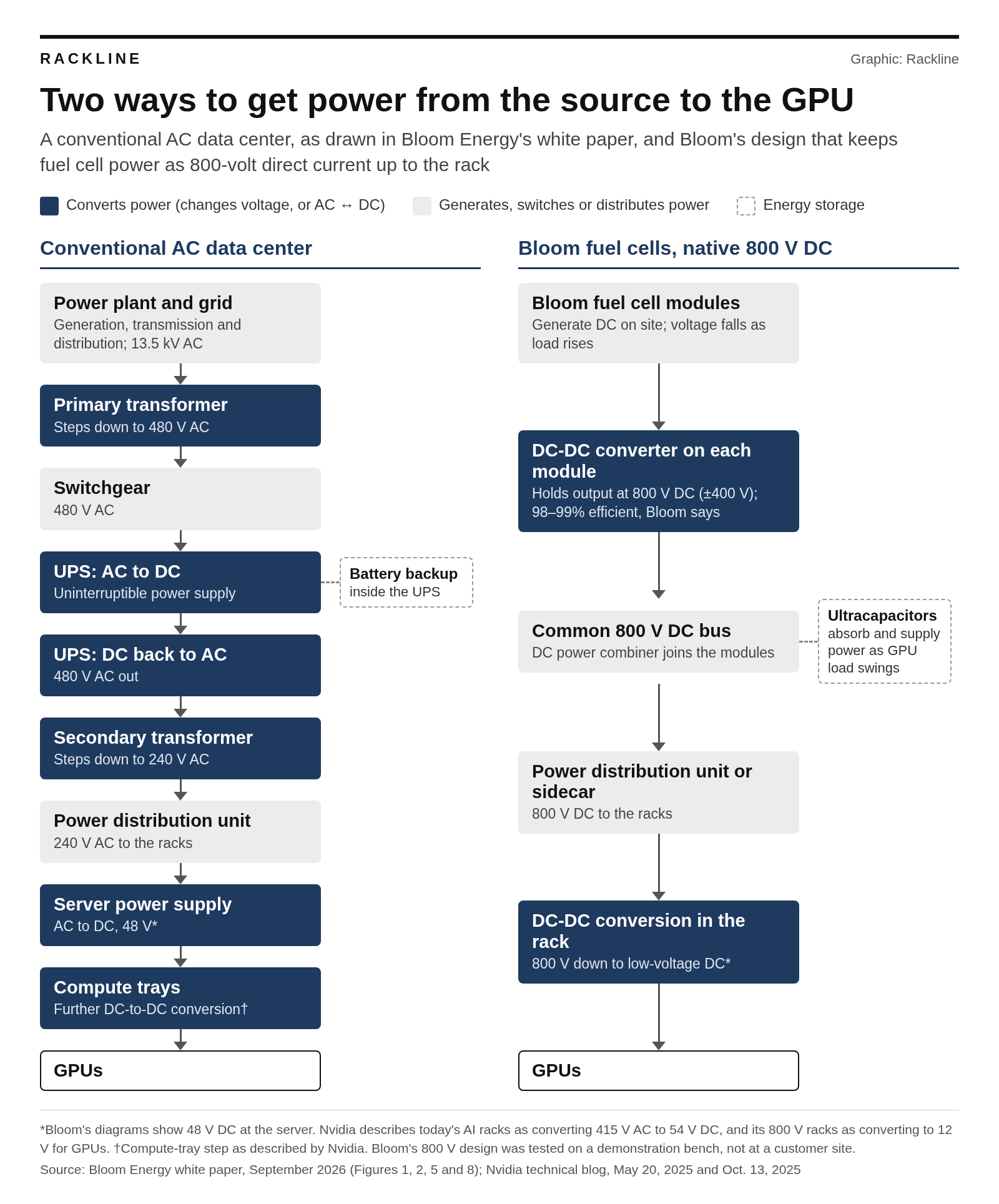
Then there is AI's own problem: power demand that lurches as GPUs work through a job in lockstep. Nvidia said in October 2025 that a rack's draw can swing from about 30% to 100% "and back again in milliseconds." Bloom places ultracapacitors on the DC bus to inject power when demand jumps and absorb it when demand drops, while the slower fuel cell adjusts. Bloom says they can also do much of the fast-response work of UPS batteries.
To test the setup, Bloom connected a fuel cell system to an 800-volt rack of Nvidia H100 servers and ran two standard AI workload profiles, Llama 2 and Stable Diffusion. It says the combined fuel cell and ultracapacitor output showed "no problem" following load steps of 50 to 100 milliseconds, and tracked oscillations of about 8 hertz in the image workload. These are Bloom's own bench results. The paper does not give the test rack's power rating or report measured efficiency, and it says any real design must satisfy "applicable electrical codes, protection requirements, and operational objectives."
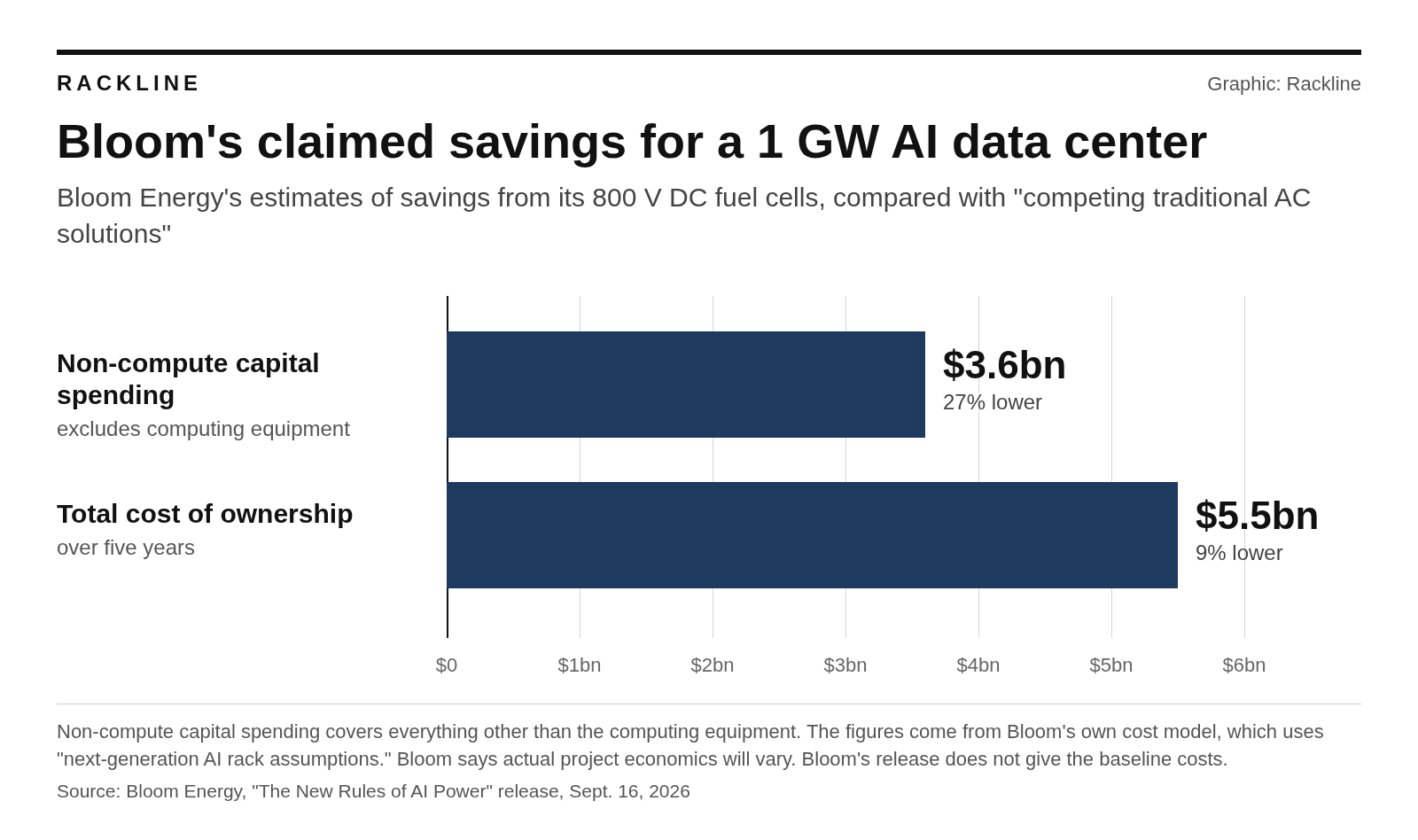
Bloom's companion report makes the money case. For a 1-gigawatt AI data center, the company says its 800-volt DC fuel cells would cut "non-compute" capital spending, meaning everything other than the computing equipment, by $3.6bn, or 27%, and five-year total cost of ownership by $5.5bn, or 9%, compared with "competing traditional AC solutions." The percentages imply bases of about $13bn and $61bn; Bloom's release breaks out neither. It credits less equipment between generation and compute, including transformers and switchgear, "where lead times are already measured in years." The figures come from its own cost model using "next-generation AI rack assumptions," and Bloom says actual results will vary by project.
"AI is not just increasing electricity demand," said KR Sridhar, Bloom's founder, chairman and chief executive. "It is catalyzing a positive transformation of how power is generated and consumed by becoming the first scale adopter of both onsite and DC power."
Bloom already sells into AI data centers at scale, though its annual report notes that its fuel cells' DC output is "traditionally delivered with a set of inverters." In April, Bloom said Oracle intends to procure up to 2.8 GW of its fuel cells, with an initial 1.2 GW contracted. In June, Brookfield expanded its framework to finance AI power projects built on Bloom's fuel cells from $5bn to $25bn. Bloom has also announced deals with American Electric Power, for up to 1 GW, Equinix, exceeding 100 MW, and CoreWeave. On July 28, it raised its 2026 revenue guidance to $3.9bn to $4.2bn. Its latest quarterly filing attributes product revenue growth partly to "a significant deployment for a large AI infrastructure customer." The annual report says the Energy Server "delivers output compatible with emerging 800 VDC data center standards," but Bloom has given no timetable for 800-volt DC deployments.
Nvidia's 800-volt posts do not name Bloom among their power partners. Nvidia's own design reaches 800 volts from the grid, converting medium-voltage AC to DC in one step at the facility, which Nvidia says removes layers of AC switchgear, transformers and power distribution units. That narrows Bloom's edge to the conversion it skips and to speed to power. The white paper describes a demonstration bench, not a customer site. And the case depends on operators generating power on site at scale rather than drawing from the grid.
For investors, the question is whether Nvidia's 2027 shift to 800-volt racks turns Bloom's fuel cells from a fast route to power, the "time-to-power" need its quarterly filing cites, into a design advantage. The first data centers built for Kyber will show which power sources developers choose to feed them.