Power & SitesEurope
Sesterce Plans €10 Billion AI Campus in Finland, Targeting 600 MW
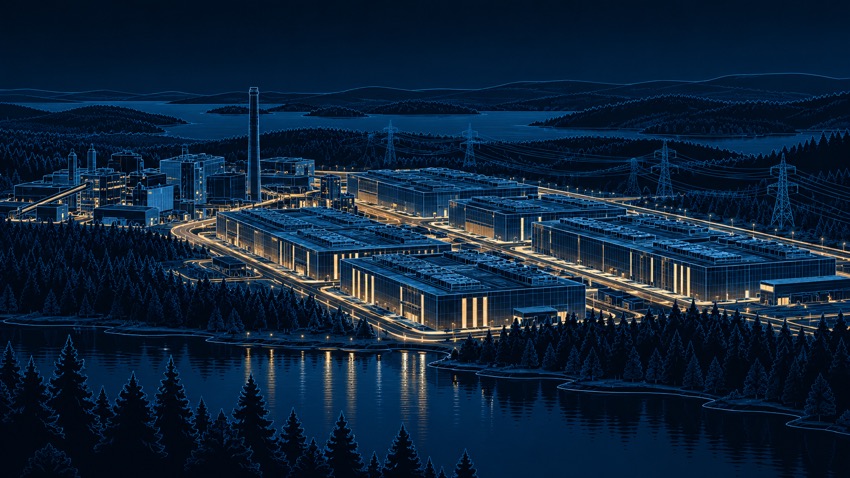
French AI infrastructure developer Sesterce has announced plans to invest more than €10 billion in a large-scale AI computing campus in Jämsä, Finland. The proposed development would repurpose the former Kaipola paper mill, transforming an existing industrial complex into an AI data center campus. The first phase is designed for 200 MW of capacity, with construction targeted to begin in 2026. A second phase would expand the campus to 600 MW.
The project is part of Sesterce’s broader strategy to develop AI computing capacity across Europe using existing industrial sites. The company says it has secured an anchor customer with committed computing workloads, although it has not disclosed the customer’s identity. The development would reuse existing electrical, water, building and logistics infrastructure at Kaipola. Sesterce estimates construction could support approximately 2,000 jobs, with another 300 positions once fully operational.
The campus will incorporate closed-loop liquid cooling, supplemented by harvested rainwater and recycled water, with no drinking water used for cooling. Sesterce has committed to enabling 1 MW of newly constructed renewable generation capacity on Finland’s electricity grid for every megawatt consumed by the campus, within ten years of commissioning. The company also plans a €10 million community fund and is evaluating waste-heat recovery. Beyond Jämsä, Sesterce has outlined a longer-term objective of developing more than 1 GW of AI computing capacity across Finland.
Anchor Customer — Claimed secured; identity undisclosed
Analysis: Finland’s Growing AI Infrastructure Market
The Jämsä announcement adds another multi-hundred-megawatt project to Finland’s expanding AI infrastructure pipeline. Sesterce’s approach is notable for industrial-site reuse, a commitment to enable new renewable generation equivalent to campus consumption, and the scale of the proposed investment.
The former Kaipola paper mill provides an established industrial location with existing utility infrastructure. Reusing these assets may reduce some site-development requirements compared with a greenfield project, although conversion to high-density AI computing will still require substantial electrical, mechanical and networking infrastructure.
Sesterce’s renewable-generation commitment is capacity-based and should not be interpreted as a guarantee that renewable electricity will match the campus’s hourly consumption. Its implementation will depend on commissioning additional generation assets.
The €10 billion-plus figure represents planned investment rather than completed capital expenditure. Sesterce has not publicly detailed the project’s financing structure, accelerator suppliers, networking architecture or construction milestones beyond the initial 2026 target. The 600 MW figure likewise represents proposed capacity, not operational or fully permitted capacity.
Sesterce’s Finnish expansion follows its participation in a separate French AI infrastructure initiative with SoftBank. The Finland project is a distinct development rather than an expansion of the French campus.
For the networking industry, a campus of this scale would eventually require substantial data center switching, optical interconnect, storage networking and data center interconnect capacity. Sesterce has not announced specific networking suppliers or technologies for Jämsä.
Business — Development and operation of AI computing infrastructure
Campus Model — AI Supercomputing Liquid Cooling Industrial Redevelopment
🌐 Tracking AI Infrastructure We’re tracking the expansion of AI data centers, high-density computing, liquid cooling and the power infrastructure supporting next-generation AI systems. Follow our AI Infrastructure coverage →