Models & LabsUnited States
Google debuts SynthID Detector tool for flagging AI-generated content, but it’s far from perfect
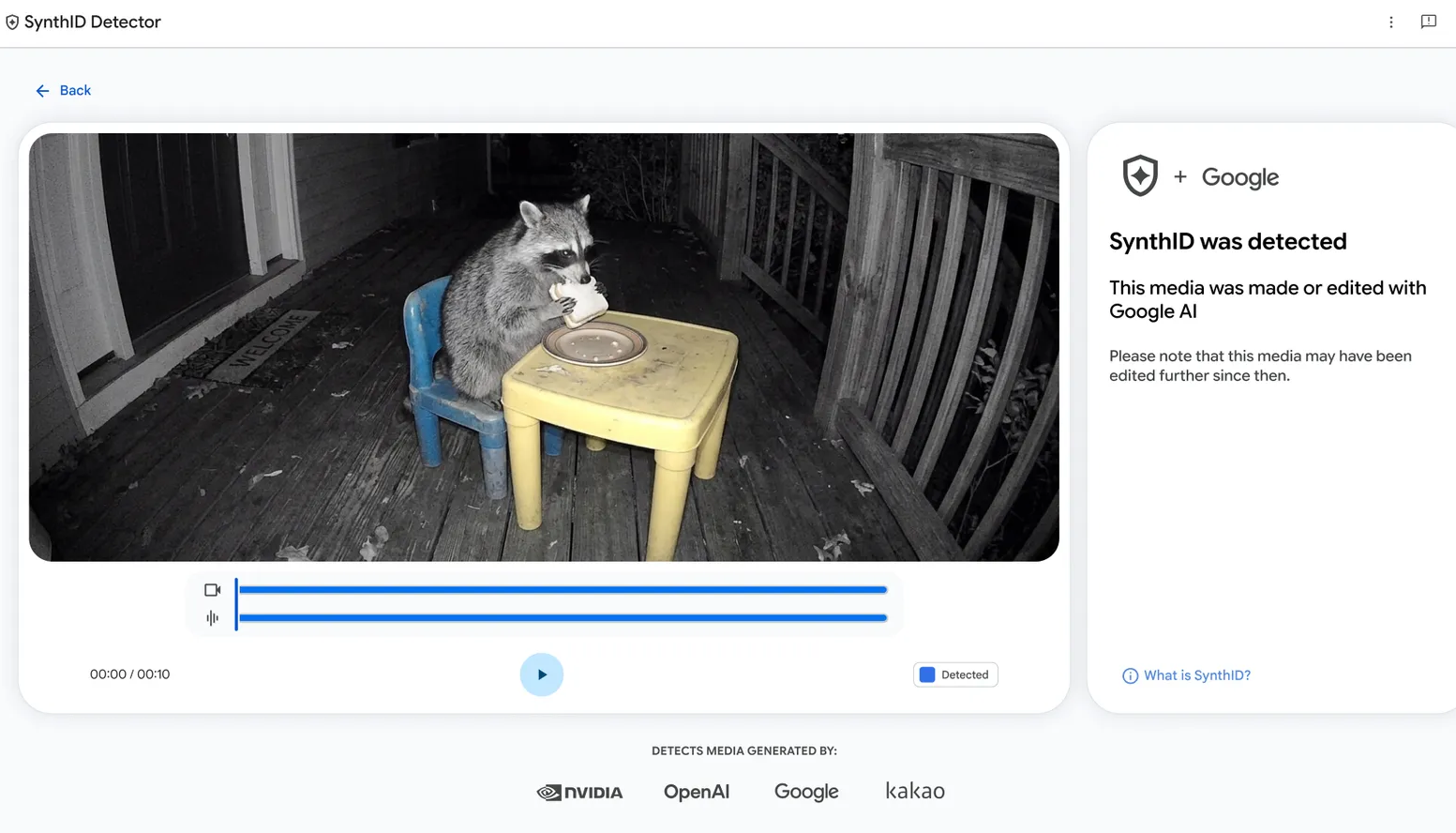
Google LLC is making its SynthID identification tools for artificial intelligence-created and AI-edited videos and images more widely available with the launch of a new service today that everyone can use.
The web-based SynthID Detector can identify images, video and audio clips that have been created using AI models from Google, OpenAI Group PBC, Nvidia Corp. and Kakao Corp. But in order to use it, people will have to sign in first, using a Google, OpenAI or Apple account. In a few weeks, the tool’s capabilities will be expanded to identify images created using Apple Inc.’s AI tools as well, such as Image Playground.
Google first developed SynthID in 2023. It’s an imperceptible watermark that’s added to AI-generated content created using tools from the above companies, but the only problem is that special tools have always been required to spot it.
Though the company has made different versions of its detection tool available to journalists and other media professionals, availability was severely restricted. Google also offers a few other ways to detect AI-generated content. For instance, there’s its Circle to Search smartphone feature, and users can also upload content to Gemini to ask if it has been created with AI or not. But with the launch of a dedicated detector tool, it’s making these capabilities more accessible,
The downside to SynthID Detector is that it has, well, downsides. For instance, because it’s designed to identify the hidden SynthID watermarks in AI content, it’s not very good at detecting AI-generated content that doesn’t have a SynthID watermark. And there’s a lot of that about.
Anthropic PBC’s Claude doesn’t use SynthID, and neither does xAI Corp.’s Grok chatbot. None of the many open-weights Chinese AI models use SynthID either. So it’s going to miss a lot of AI-generated content regardless.
Another issue with SynthID Detector is that it cannot distinguish between images, video and audio that has been entirely created from scratch or just edited using AI. So in the case of content that has been edited, it won’t be able to reveal which part is fake and which part is real.
SynthID Detector is still a step in the right direction, but it’s not nearly enough. The reality is that there’s still no foolproof way of verifying AI-generated content, partly because there are so many different standards for watermarking model’s creations.
Meta Platforms Inc. has been experimenting with its own watermarking tools and has developed a system for identifying images created with Muse Image, but it’s useless when confronted with images created with third-party models. Unless all of the major AI model makers, including the Chinese ones, decide to get on the same page and create some kind of universal standard for watermarking AI content, it’s likely that there will never be a reliable way to detect such material.
Given its influence and the fact it already has several technology heavyweights on board already, it’s likely that Google is in the best position to make some kind of universal standard happen. The company does at least seem to recognize the problem, and said on the SynthID Detector’s website that it’s “continuously working on extending our partnerships” to allow it to detect more types of AI-generated media.
“Building industry-wide standards takes time, and different content types (image, audio, video) have different technical requirements,” Google said. “The goal is a layered ecosystem where watermarking, metadata standards, and verification tools work together across the industry.”
Support our mission to keep content open and free by engaging with theCUBE community. Join theCUBE’s Alumni Trust Network, where technology leaders connect, share intelligence and create opportunities.
Are you an AWS customer? Support SiliconANGLE financially by buying your AWS services from our Marketplace portal page and links: https://siliconangle.com/aws-marketplace/
Founded by tech visionaries John Furrier and Dave Vellante, SiliconANGLE Media has built a dynamic ecosystem of industry-leading digital media brands that reach 15+ million elite tech professionals. Our new proprietary theCUBE AI Video Cloud is breaking ground in audience interaction, leveraging theCUBEai.com neural network to help technology companies make data-driven decisions and stay at the forefront of industry conversations.
Automation Anywhere acquires Boost.ai to expand customer-facing voice AI
Liquid AI builds personal AI around device-level context
Willow taps CoreWeave to simplify AI model training
Oratomic raises $475M for neutral-atom quantum computing, Universal Quantum nets $100M+
Docusign adds a desktop PDF editor to its Intelligent Agreement Management platform
Harness acquires Augment Code to bridge software engineering from idea to deployment
EMERGING TECH - BY KYT DOTSON. 4 HOURS AGO
Join our community