CapitalUnited States
Turba Labs Secures $52M to Optimize Existing AI Infrastructure
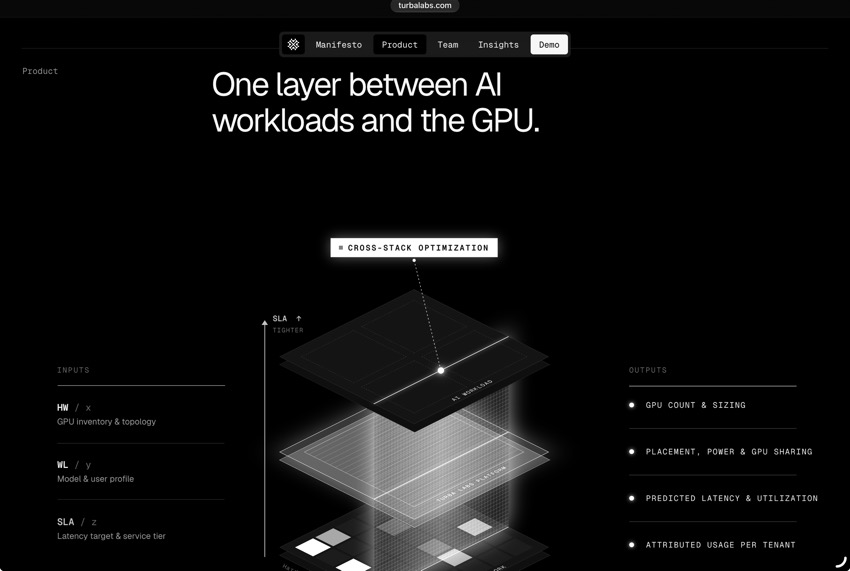
Turba Labs has secured $52 million in funding led by Creandum and Cusp Capital to develop an AI performance platform designed to increase useful compute from existing infrastructure. The October 6 announcement outlines an approach that combines analytics, a calibrated digital twin and orchestration to optimize workloads across compute, memory and networking. The company’s ambition is to double useful compute without building additional data centers. The financing comprises combined seed and Series A funding, according to The Wall Street Journal.
The platform treats AI workloads and their underlying infrastructure as one execution system. Before deployment, it predicts how changes in models, demand or hardware will affect performance, reliability and cost. During operation, it adjusts routing, admission control, replica counts, placement, batching and parallelism within memory, service and power constraints. Turba targets neoclouds and enterprises operating AI infrastructure, emphasizing application output that meets service objectives rather than GPU utilization or raw tokens per second alone.
Turba reports a modeled mixed-inference example in which blended cost per token declined by a factor of 9.4—approximately 89%—across five workload profiles and six optimization measures while maintaining service objectives. The company explicitly identifies this as a scenario-specific modeled result, rather than a measured production outcome or universal performance guarantee. Its stated evaluation approach includes comparisons against well-tuned baselines, representative workloads and demand bursts, with latency, throughput, cost and energy reported separately.
• $52 million in funding, with Creandum and Cusp Capital named as lead investors.
• Connects analytics, a calibrated digital twin and orchestration across compute, memory and networking.
• Predicts the effects of model, demand and hardware changes before operators implement them.
• Coordinates routing, admission, replicas, placement, batching and parallelism within service and resource limits.
• Modeled example: approximately 89% lower blended cost per token; no universal or measured production improvement established by this example.
• Founded by Dr. Patrick Jahnke and Dr. Hans-Juergen Schmidtke, bringing experience from SAP and Meta.
“Useful work is the only metric that matters,” wrote founders Dr. Patrick Jahnke and Dr. Hans-Juergen Schmidtke in the announcement.
The founders’ backgrounds help explain Turba’s focus on dependencies between software workloads and physical infrastructure. Jahnke previously worked at SAP on AI systems and complex enterprise platforms; Turba’s biography identifies experience in predictive maintenance and utilization optimization. His academic work also connects directly to the platform’s proposed feedback loop: his 2021 doctoral thesis at Technical University of Darmstadt examined observing, predicting and enforcing properties of interactions in data centers. The connection between that research and Turba’s analytics, prediction and orchestration architecture is an editorial inference, rather than evidence that the commercial platform implements the thesis directly.
Schmidtke brings a complementary history in networking, optical communications and large-scale infrastructure. Turba says he recently led AI infrastructure systems engineering at Meta and executed large-scale deployments. Optica’s archived biography documents earlier responsibilities in Facebook’s Infrastructure Foundation team, followed by a career history that includes Juniper Networks’ CTO office, advanced technologies and converged-core architecture. Before Juniper, he led Nokia Siemens Networks’ North American fixed-network operator business. His physics education included the University of Düsseldorf and the Max Planck Institute of Quantum Optics, with a doctorate from the University of Würzburg. This experience provides relevant context for Turba’s decision to model network and memory constraints alongside accelerator performance.
Headquarters — Palo Alto, California, United States; additional office in Heidelberg, Germany.
Founders — Dr. Patrick Jahnke and Dr. Hans-Juergen Schmidtke.
Platform — AI performance software combining analytics, digital-twin modeling and orchestration.
Funding — $52 million announced October 6, 2026; lead investors Creandum and Cusp Capital.
Target Markets — Neoclouds and enterprises operating AI infrastructure.
Coverage — GPU optimization • Digital twins • AI inference • Training • Infrastructure orchestration
June 21, 2026 · Rack-Scale Infrastructure CoreWeave Details Rack Engineering for NVIDIA Vera Rubin Examines coordination of networking, cooling, scheduling and fleet management in rack-scale AI systems.
March 17, 2026 · Digital Twins and Power NVIDIA DSX Architecture Targets Token-Per-Watt Optimization Explores integrated simulation and optimization across AI factory compute, networking, power and cooling.
November 3, 2025 · GPU Orchestration Rafay and Aviz Join Forces to Streamline GPU Cloud Orchestration Connects GPU lifecycle management with fabric automation and observability for multi-tenant infrastructure.
July 29, 2025 · AI Memory Infrastructure Enfabrica Launches Elastic AI Memory Fabric Addresses memory bottlenecks and stranded compute through pooled memory accessible over Ethernet.
July 17, 2024 · AI Fabric Validation Juniper opens Ops4AI Lab in Silicon Valley Highlights workload validation, congestion control and network tuning aimed at improving GPU utilization and job completion times.
🌐 We’re tracking the latest developments in AI infrastructure. Follow our ongoing coverage at https://convergedigest.com/category/ai-infra/