PolicyUnited States
Getting It Right Together: The State Regulatory Lens on America’s Large-Load Future
Who pays, who bears the risk, who decides, and when? Virginia Commissioner Jehmal Hudson makes a forceful case that serving large-load growth requires credible commitments, earlier coordination, and ratepayer protections built into investment decisions.
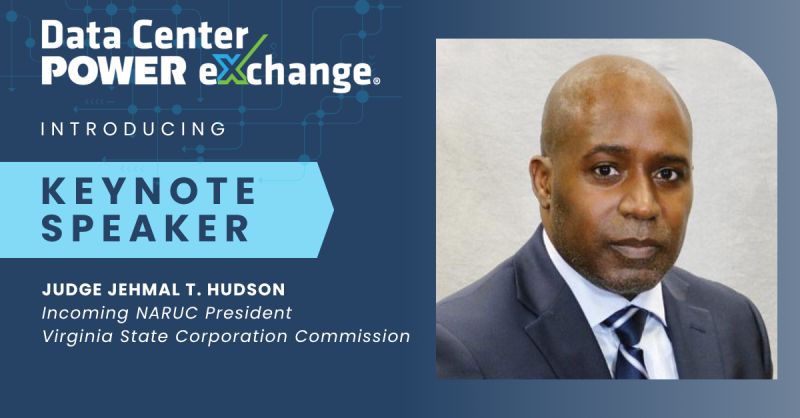
Judge Jehmal T. Hudson, commissioner of the Virginia State Corporation Commission and incoming president of the National Association of Regulatory Utility Commissioners (NARUC).
Good afternoon. Thank you to POWER Magazine for inviting me to join you today.
It is a pleasure to be with so many people thinking seriously about one of the most consequential issues facing the electric industry: how we meet extraordinary new demand while maintaining the affordability, reliability, and financial discipline customers expect from the electric system.
I come to this conversation wearing two hats. First, I serve as a Commissioner of the Virginia State Corporation Commission. Virginia gives us an important vantage point because we are confronting, in real time, many of the questions other states may increasingly face as large loads seek to connect to the grid.
Second, later this year, I will have the privilege of serving as President of the National Association of Regulatory Utility Commissioners.
From those perspectives, I believe the regulatory conversation is evolving. We are moving from project-by-project reaction toward system-level strategy.
Data center growth is no longer simply a utility-service question or a single interconnection proceeding. At sufficient scale, it touches utility commissions, state energy offices, economic development agencies, consumer advocates, local governments, utilities, communities, large-load customers, RTOs, and federal regulators.
Increasingly, states must think about large-load growth as a whole-of-government and whole-of-system challenge. And I believe four questions should guide that work:
Who pays? Who bears the risk? Who decides? And increasingly: When do we decide?
From Individual Projects to System-Level Strategy
For much of the electric industry’s history, regulators planned around relatively predictable patterns of demand. Today, the scale, speed, and concentration of proposed load growth are challenging those assumptions.
A single customer may seek hundreds of megawatts. Multiple customers may seek service in the same geographic area. Generation, transmission, substations, and distribution facilities may all be implicated.
That means a decision involving one customer can have consequences across the entire system. So we need to look beyond individual projects and ask what all of this means collectively for the electric system and existing customers.
If we underestimate demand, we can face reliability problems, insufficient generation, delayed economic development, and inadequate infrastructure. But if we overestimate demand, we can construct billions of dollars of infrastructure that someone still has to pay for.
That brings us to one of the hardest questions facing regulators: What demand is real?
The electric system cannot be planned around press releases. We cannot simply add every requested megawatt together and assume all of it will appear exactly when requested.
Regulators increasingly must look not only at the megawatts requested, but at the certainty behind those megawatts. Does the customer control the site? Are permits progressing? Has financing been secured? When will the load materialize? How quickly will it ramp? And what happens if the project is delayed, downsized, or never built?
If utilities build too far ahead of demand, existing customers may become exposed to underutilized assets and stranded costs. If utilities build too slowly, legitimate projects may not receive service when needed.
So the answer cannot be to build everything requested. And the answer cannot simply be to say no. The answer is better information and greater certainty.
The more confidence we have in the demand forecast, the more confidently we can make decisions about generation, transmission, distribution, resource adequacy, and cost responsibility.
Tariff Design Is Risk Design
That brings me to who pays and who bears the risk. Traditionally, tariff design has been viewed primarily as a mechanism for determining how utility costs are recovered.
With very large loads, regulators increasingly must think about it more broadly. Tariff design is also risk design.
Minimum usage commitments, contract duration, collateral, exit fees, construction contributions, and separate rate classes can all help determine who bears the risk before infrastructure is constructed.
Virginia provides a concrete example. In November 2025, the Virginia State Corporation Commission approved a new rate class for Dominion Energy Virginia’s largest customers.
Beginning January 1, 2027, the GS-5 class will apply to customers with measured or contracted demand of 25 megawatts or greater on a contiguous site and a measured or expected load factor of at least 75%.
But creating a separate class was only part of the decision. The Commission also established stronger financial commitments associated with service to those customers.
Certain customers will be required to pay a minimum of 85% of contracted distribution and transmission demand and 60% of generation demand, among other requirements.
Why does that matter? Because infrastructure decisions are made based on anticipated demand.
If a utility constructs infrastructure based on a customer’s representation that it needs a certain amount of capacity, and that demand does not materialize, the cost does not disappear. Someone pays.
The regulatory question is whether that risk should automatically migrate to other customers.
Virginia is also examining transmission cost responsibility. In another proceeding, the Commission directed Dominion to require mandatory contributions in aid of construction for defined transmission facilities necessary to directly connect certain new large-load facilities.
The Commission also left open whether some upstream transmission costs might warrant different treatment.
These are difficult questions because electric infrastructure can create broader system benefits. So cost causation cannot be the end of the analysis.
We also must ask: Who caused the cost? Who benefits? Who bears the risk? And therefore, who should pay?
Match Physical Commitments With Financial Commitments
That leads to a principle I believe deserves greater attention: Physical commitments should increasingly be matched by financial commitments.
If the electric system is being asked to make a substantial physical commitment to serve a customer, what financial commitment should appropriately accompany that request?
If hundreds of millions—or potentially billions—of dollars are invested based on anticipated demand, what assurance exists that the customer will remain financially responsible for an appropriate portion of that commitment?
The answer will differ across jurisdictions. But the scale of the financial commitment should bear some reasonable relationship to the scale of the system commitment being requested.
And there is an important connection here to speed to power. Financial discipline does not necessarily slow development.
Greater financial certainty can produce greater planning certainty. That can allow utilities and regulators to distinguish serious projects from speculative demand and support faster infrastructure decisions for projects truly ready to proceed.
So customer protection and speed to power do not have to compete. Properly designed, they can reinforce one another.
Coordination Before Decisions Harden
That brings me to who decides—and when. Large-load development can involve commissions, utilities, economic development agencies, state energy offices, local governments, communities, RTOs, FERC, and others.
The challenge is that these institutions often make decisions on different timelines. A site may be selected before the utility fully understands its infrastructure implications. Economic development incentives may be discussed before total system costs are known. A utility may begin planning before the commission has determined the appropriate tariff structure.
By the time all of the institutions are talking to one another, important decisions may already have hardened. That is why early coordination matters.
Earlier information-sharing about potential sites, likely demand, infrastructure constraints, resource needs, community concerns, and development timelines can reduce delay, rework, stranded-investment risk, and public opposition.
But coordination does not mean collapsing institutional responsibilities. State commissions must preserve their independent and adjudicatory roles. FERC has its responsibilities. RTOs have theirs. Local governments and state policymakers have theirs.
Coordination should strengthen jurisdiction—not erase it. That is why regulatory sequencing will become increasingly important.
It is not simply who makes the decision. It is whether the right information reaches the right institution at the right time.
Ratepayer Protection and Public Trust
This brings me to ratepayer protection. For regulators, the important question is how that principle translates into actual commission practice.
To me, that means asking hard questions before costs become embedded in rates. What infrastructure is actually necessary? What assumptions support the forecast? Which investments primarily serve the new customer? Which investments provide broader system benefits? What financial protections exist? What happens if demand does not materialize? And what portion of that risk should appropriately be borne by the broader customer base?
Those questions are much easier to address before infrastructure is constructed than afterward. That is why I think about ratepayer protection this way:
Ratepayer protection is not simply about allocating costs after they have been incurred. It is about allocating risk before the investment decision is made.
And that connects directly to public trust. Data center growth can bring significant economic benefits.
But communities are also asking questions about electricity rates, reliability, water, land use, infrastructure, and whether the costs and benefits of growth are being shared fairly.
Regulators maintain trust not by promising that every decision will satisfy every stakeholder, but by demonstrating that the process is disciplined, transparent, and fair. That means explaining our reasoning and being clear about who is bearing which costs and risks.
It means listening to utilities and large customers—but also existing customers, consumer advocates, and communities. If the public believes that benefits are private while risks are socialized, confidence in the system will erode.
Durable growth therefore requires more than infrastructure. It requires public confidence in the decisions that allow that infrastructure to be built.
NARUC: Moving From Diagnosis to Solutions
This brings me to my incoming NARUC presidency. Our three-year theme is “Uniting Regulators, Harmonizing Impact.” For the coming year, my subtheme is “Getting It Right Together.”
And I believe we are reaching an important point in the large-load conversation. We have spent considerable time diagnosing the challenge. Now we need to move increasingly toward solutions.
Work across NARUC, NCEP, and the states is helping identify a growing toolbox: early interagency coordination, improved load forecasting, shared information, large-load interconnection policies, large-load tariffs, financial commitments, and greater alignment around economic-development and infrastructure goals.
No single approach will work everywhere. Virginia does not have every answer. Neither does another state, FERC, an RTO, a utility, or a hyperscaler. But states should not have to learn in isolation.
One commission may be examining minimum demand commitments. Another may be developing a separate tariff. Another may be addressing collateral or exit fees. Another may be confronting transmission cost allocation. Another may be experimenting with flexible service.
We should compare those approaches, understand what is working, and identify principles that can travel across state lines without assuming every state must reach the same outcome.
That is what Getting It Right Together means. It does not mean getting it identical together. It means learning together.
And large-load growth intersects with each of my six priorities for NARUC: affordability; the need for new generation; resource adequacy; balancing costs as utilities evolve; maintaining reliability; and investment needs and ratepayer pressures.
This is not simply a data-center issue. It is a test of whether our regulatory institutions can adapt to rapid economic and technological change while maintaining affordability, reliability, financial discipline, and public trust.
So let me close where I began. We are moving from project-by-project reaction toward system-level strategy. And four questions should guide us.
Who pays? Cost allocation should reflect both cost causation and broader system benefits.
Who bears the risk? Extraordinary or uncertain demand should not automatically transfer extraordinary risk to customers who did not create it.
Who decides? We need coordination among commissions, state policymakers, FERC, RTOs, utilities, local governments, customers, and communities while respecting institutional responsibilities.
And: When do we decide? Because early coordination and regulatory sequencing can help us identify risks before sites are locked in, infrastructure is committed, and costs become difficult to unwind.
The demand opportunity is real. The economic opportunity is real. The infrastructure challenge is real. And the risks are real.
Our job as regulators is not to stop growth. It is to create the conditions for durable growth—growth supported by better information, credible commitments, fair cost allocation, reliable infrastructure, and public confidence.
We need to reduce uncertainty without reducing scrutiny. We need to accelerate infrastructure without accelerating the transfer of risk to customers.
And the ultimate question is not simply whether we can power the next data center. It is whether we can build an electric system capable of supporting the next era of American economic growth while remaining affordable, reliable, financially sustainable, and worthy of the public’s trust.
Growth is coming. Our responsibility is to accommodate it responsibly. To understand who pays. Who bears the risk. Who decides. And when those decisions need to be made.
That is the regulatory challenge. That is the opportunity before the states. And that is what I mean when I say: Getting It Right Together.
—Judge Jehmal T. Hudson is serving his second term as a commissioner of the Virginia State Corporation Commission. He is first vice president and incoming president of the National Association of Regulatory Utility Commissioners (NARUC). Before joining the Commission, he served as vice president of government affairs at the National Hydropower Association and spent 10 years at the Federal Energy Regulatory Commission, including as director of government affairs. He also serves on the Electric Power Research Institute’s Advisory Council.
Creating Value from Data: Maximizing Plant Performance Through Real-Time Analytics
Modern process industries are experiencing fluctuating market conditions and tight operational margins, leading chemical engineers to rely on real-time data to boost efficiency and reduce costs. Yet, many organizations are at different stages in their digital transformation journey. Some are just starting, while others are looking to optimize existing solutions. This webinar explores practical ways […]
Smart MRO: Using Technology and Assessment to Enhance Power Plant Performance
How One Electric Utility Is Using AI and Extreme Weather Modeling to Make Critical Grid Decisions
archives + podcasts + webinars + e-letters + video + exclusive content + events + much more!
For over 142 years, POWER has been the unwavering pillar of the power and energy industry, offering unparalleled insights on the latest trends, best practices, and news through our robust channels: print, digital media, and in-person events.