Models & LabsUnited States
Trusted Control Is the Foundation for AI in Power Generation
As fleets grow more diverse, reliable operational data—not algorithms—could decide how useful artificial intelligence (AI) becomes in the control room.
“If a 1-GW offshore wind park unexpectedly goes offline, the impact on grid stability can be significant,” Mark Robens, sales head for North and Western Europe for Controls & Digitalization at Siemens Energy, said as a guest on The POWER Podcast. That is why, Robens argued, renewables now belong in the same “critical infrastructure” category as large conventional power plants, and why the systems that control them must meet the same standard: trusted, secure, and reliable.
AI raises the stakes on that standard. Robens said the more digitalized and interconnected operations become, the more they depend on trusted control, because AI is only as useful as the operational data beneath it. Before AI can create value, he said, operators need a trusted operational foundation.
Orchestrating Systems, Not Assets
Power generation has become “more heterogeneous,” Robens said. Operators that once managed homogeneous fleets now run conventional generation alongside wind farms, solar plants, battery energy storage, and other distributed assets, all of which must work together to hold the grid steady. The technologies change, he said, but the requirement does not.
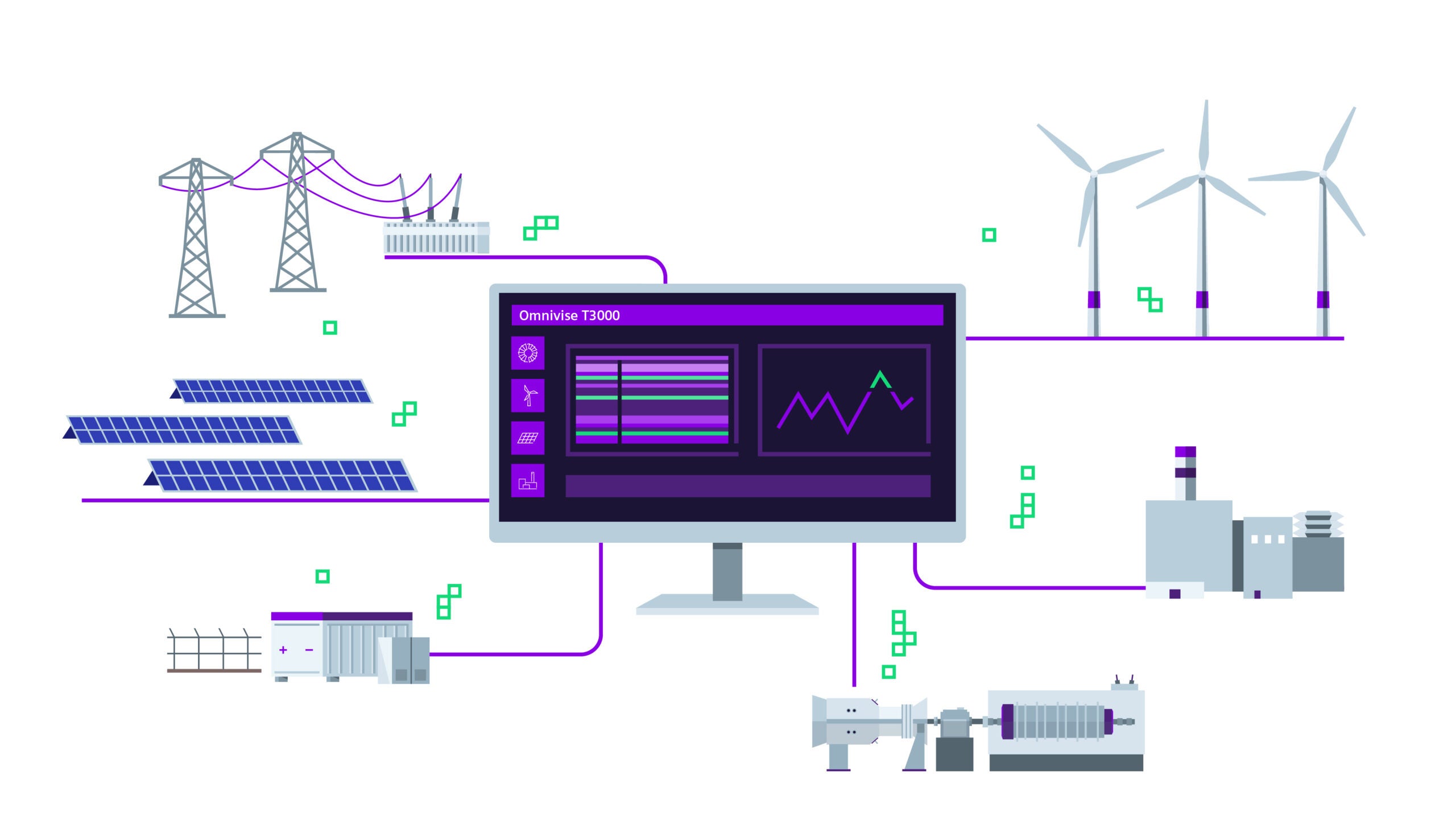
He pointed to a recent Siemens Energy project for a major energy company in South America. The customer runs a microgrid across multiple locations that combines gas turbines, wind generation, and battery storage. According to Robens, the challenge was not controlling any one asset but orchestrating an entire energy system: deciding when conventional generation should take over, when batteries should charge or discharge, and how to balance sustainability and reliability across a wide geographic area. The Omnivise T3000 control system provides the integrated operational layer for the site, he said.
Customers are increasingly asking about whole portfolios rather than individual units, Robens added. “They are no longer talking to us about a single asset; they are talking to us about a full portfolio of generation assets.”
Why Cybersecurity and Data Quality Come First
“There is a lot of excitement about AI right now, and I would say rightly so,” Robens said. “But AI is only as good as the information it has access to.” If operational data is incomplete, inconsistent, or stripped of context, he said, AI will not produce reliable recommendations.
Cybersecurity carries similar weight. As plants connect to external information technology systems and depend on digital applications, he said, the challenge grows, and security “can never be treated as an afterthought.” Robens said T3000 was designed to IEC 62443 and the ISO 27000 family of standards, which regulators increasingly reference for critical infrastructure. Whether the framework is NERC CIP in North America, KRITIS in Germany, or NIS regulations in Europe, he said, the expectation is the same.
From a Control Core to a Connected Ecosystem
Many plants have already digitalized, Robens said, but they often lack integration. Information sits in silos, applications run independently, and workflows still require manual intervention. Plants without a common, structured data foundation are limited in how well they can use AI, he said. “A power plant of the future will not be built on isolated systems. It will be built on connected intelligence.”
Siemens Energy’s answer is the Omnivise ecosystem, which Robens described as a framework that pools data from the expert applications running at a plant. He summarized the relationship between the two products as “control across, value above.” T3000 integrates assets horizontally across technologies and sites, he said, while the ecosystem extends vertically to connect operational data with applications, fleet operations, energy management, and market-facing processes. The ecosystem is vendor agnostic, he noted, and customers do not need T3000 to use it.
As an example of the ecosystem side, Robens cited EML S.A., a Portuguese energy company moving its renewable fleet from feed-in tariffs toward direct participation in energy markets. According to Siemens Energy, seven onshore wind farms totaling about 250 MW were connected through Omnivise T3000 Edge to a cloud-based operations and analytics environment. The setup gives EML a single interface for fleet monitoring, alarm handling, and supervisory control across all seven sites, providing the transparency needed to coordinate market dispatch in line with transmission system operator procedures. It will also support forecasting and dispatch and bid optimization, and the architecture is designed to extend to additional energy management functions and hybrid technologies such as solar and storage.
Practical AI, Not Replacement
Robens said AI’s value lies not in replacing operators but in helping them “make decisions faster” and “focus on higher value tasks.” Siemens Energy is working on AI-assisted root cause analysis, turbine tuning, incident response guidance, interactive manuals and reporting, and operational agents that give control room staff recommendations based on operating conditions. All of them, he said, depend on trusted, connected data.
Fully autonomous plants aren’t here yet, Robens acknowledged, but he said increasing levels of automation and autonomy are part of the industry’s future, and that AI is the key to getting there. Together with Volkswagen in Wolfsburg, Germany, Siemens Energy demonstrated 72 hours of unmanned operation at a power plant. That doesn’t mean an autonomous plant has arrived, Robens said, but it shows “where the industry is heading.”
To hear the full interview with Robens, listen to The POWER Podcast. Click on the SoundCloud player below to listen in your browser now or use the following links to reach the show page on your favorite podcast platform:
For more power podcasts, visit The POWER Podcast archives.
— Aaron Larson is POWER’s executive editor.
Creating Value from Data: Maximizing Plant Performance Through Real-Time Analytics
Modern process industries are experiencing fluctuating market conditions and tight operational margins, leading chemical engineers to rely on real-time data to boost efficiency and reduce costs. Yet, many organizations are at different stages in their digital transformation journey. Some are just starting, while others are looking to optimize existing solutions. This webinar explores practical ways […]
Smart MRO: Using Technology and Assessment to Enhance Power Plant Performance
How One Electric Utility Is Using AI and Extreme Weather Modeling to Make Critical Grid Decisions
archives + podcasts + webinars + e-letters + video + exclusive content + events + much more!
For over 142 years, POWER has been the unwavering pillar of the power and energy industry, offering unparalleled insights on the latest trends, best practices, and news through our robust channels: print, digital media, and in-person events.