Power & SitesUnited States
Kioxia Adds Direct Liquid Cooling to PCIe 5.0 Enterprise SSDs
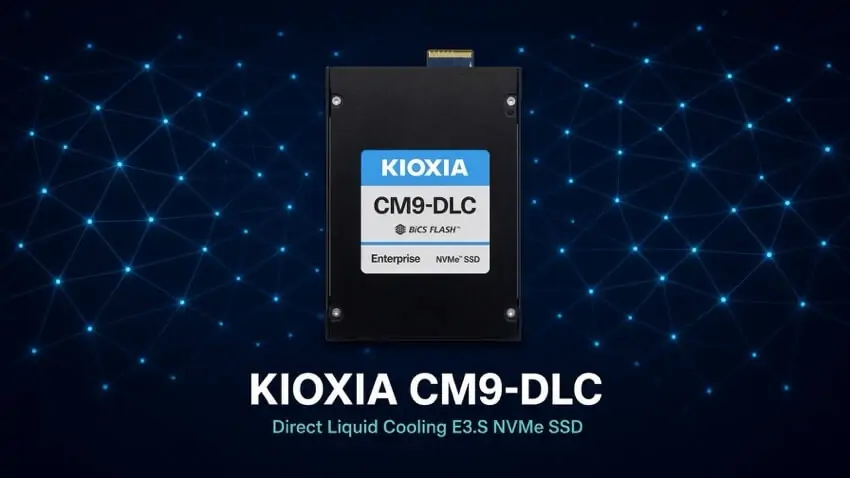
Kioxia has added direct liquid cooling (DLC) options to its CM9 Series enterprise SSDs, enabling cold-plate cooling in E3.S server designs. The drives also support conventional air cooling. Kioxia is sampling the CM9 Series to selected customers and showcased the new models at OCP Global Summit 2026 in San Jose.
The PCIe 5.0 drives support NVMe 2.0 and dual-port E3.S operation, with sequential throughput rated up to 14.8 GB/s for reads and 11 GB/s for writes. Read-intensive configurations offer capacities up to 30.72 TB with 1 drive write per day (DWPD), while mixed-use configurations offer up to 25.6 TB with 3 DWPD. Kioxia identifies SSD context caching as a target application.
CM9-DLC Specifications
KIOXIA CM9-DLC | PCIe 5.0 Enterprise SSD
Cooling — Cold-plate direct liquid cooling or air cooling
Capacity — Up to 30.72 TB (1 DWPD); 25.6 TB (3 DWPD)
Random I/O — Up to 3.4M read IOPS; 800K write IOPS
Standards — NVMe 2.0, NVMe-MI 1.2c, OCP Datacenter NVMe SSD v2.5
The product supports NVMe-MI 1.2c and the OCP Datacenter NVMe SSD v2.5 specification. Kioxia has not announced general availability or pricing. Sample specifications may differ from mass-production drives.
Direct liquid cooling is expanding from processors and accelerators toward other server components as AI racks become more densely populated. SSD cold-plate support provides system designers with an additional option for managing storage thermals without relying exclusively on airflow. The announcement does not quantify cooling-related energy savings, which depend on overall server design and operating conditions.
AI inference also creates new opportunities for SSD context caching. Large key-value caches can exceed available GPU memory, encouraging tiered memory architectures that place less latency-sensitive data on lower-cost storage. SSD latency remains significantly higher than GPU high-bandwidth memory, so the performance benefits depend on cache placement and software orchestration.
Kioxia’s CM9-DLC introduction connects these storage and thermal requirements. Production qualification, availability and system-level performance data will help determine deployment economics.
Company Profile: Kioxia
Origins — Toshiba Memory separated in 2017; renamed Kioxia in 2019
Technology — BiCS FLASH 3D NAND; PCIe/NVMe enterprise SSDs
Markets — Cloud, AI infrastructure, enterprise storage, mobile and automotive
🌐 We’re tracking AI infrastructure developments. Follow our ongoing coverage at Converge Digest AI Infrastructure.