Models & LabsUnited States
With GPT-6, ChatGPT’s responses are much more visually appealing and interactive
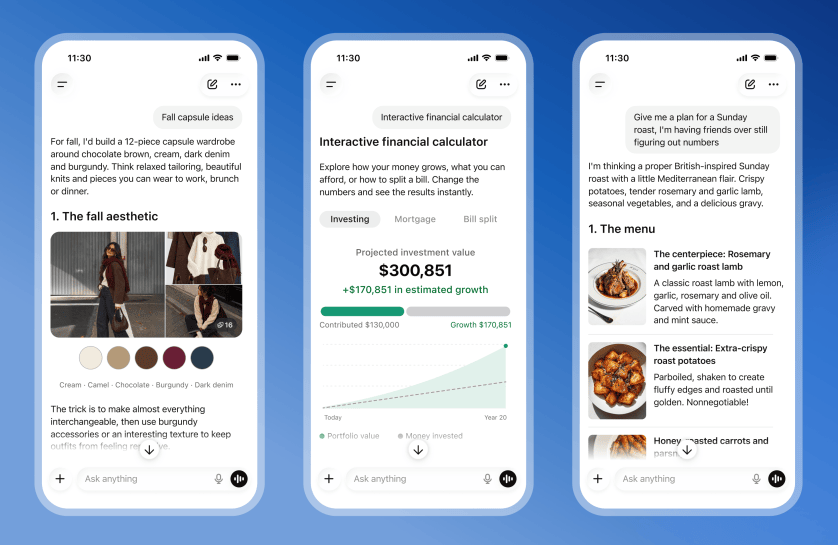
OpenAI Group PBC says ChatGPT is moving away from its traditional wall-of-text responses and giving users a more interactive user interface to play with.
In a media briefing today, the company said its GPT-6 models will now be able to access an “Intelligent UI” that will allow the chatbot to generate more visual outputs when it deems necessary, replacing words with graphics, tappable buttons, forms and charts” that will provide a much more interactive experience.
ChatGPT will determine for itself when an answer needs a more visually appealing response and interactive elements for the user to explore a topic more deeply. In such instances, the model will integrate these directly with its response.
In an example, OpenAI showed someone asking ChatGPT how to piece together a seven-speed bicycle. Rather than just churning out endless text that explains everything, it instead generated a complete design breakdown, complete with visualizations of each of the main parts and a clickable button that allows readers to learn more about each of them.
In a second example, a user asked ChatGPT to create a plan for a lamb roast with pictures of each dish, plus a recipe that allowed the user to alter the number of guests in order to recalculate the amount of ingredients required.
OpenAI explained that ChatGPT will generate these visualizations from a library of components that the GPT-6 models were pretrained on. For more basic prompts and questions, the chatbot will stick with the old text-only format, but users will have the option to request a more interactive response at any time, and it will reformat the response accordingly.
The goal with this update is to make “learning complex topics easier,” OpenAI Product Manager Aarush Selvan said in the briefing. The intelligence UI may also help to make ChatGPT more accessible and increase its appeal, though Selvan didn’t say this directly.
ChatGPT has predominantly been a text-based interface,” Selvan said. But the company wants to help people get things done, and it believes that “from the everyday things like planning a recipe or a trip or even trying to learn something, the most helpful answers aren’t just text.”
The visual UI is primarily designed to make ChatGPT easier for people to use and retain information, Holger Mueller of Constellation Research told SiliconANGLE. “We’ve long known that usability is one of the primary factors driving adoption of software, and the text-only interface doesn’t really help when people when it comes to information absorption or processing,” the analyst said.
Mueller believes that this is such a significant move by OpenAI that it could signal the opening of a new front in the battle of the AI assistants, especially if Anthropic responds with a similar visual aesthetic in Claude. “Anthropic will be under pressure to respond to this in the next few weeks, or it could even do so in just a few days if something similar was already in the works,” he said. “This could lead to usability and not just the quality of the model and its answers becoming the deciding factor in which chatbots people want to use. If Anthropic fails to respond to this, OpenAI has a very strong differentiator that would likely change many people’s choices once they see it.”
That is assuming that the Intelligent UI works as well as advertised, of course. It’s worth noting that it’s not an entirely original idea. In fact, it’s somewhat reminiscent of Google LLC’s “Generative Interface,” which was introduced with the launch of Gemini 3 last year, although it seems to be a bit more colorful and more graphics-heavy. When Google introduced that feature, there was a lot of excitement around it, but it doesn’t really appear to have differentiated Gemini as a chatbot all that much.
There may be other considerations, too. OpenAI didn’t say if the Intelligent UI would mean higher token consumption, but that does appear to be the case with all of those extra elements being generated, so that’s something users might want to watch out for. It’s also not clear how susceptible these visual elements may be to the problem that plagues every AI chatbot, namely hallucinations.
OpenAI, however, seems to be pushing for AI to become more visually appealing. Earlier this week, the company revealed it would soon introduce the first image-based ads in ChatGPT’s responses. More cynical users might think that the Intelligent UI may make it more difficult to see which responses are ads and which are the chatbots own. Regardless, ads are almost certainly going to become a part of every AI chatbot at some point.
OpenAI said the Intelligent UI is being made available from today for ChatGPT Plus, Pro, Business and Enterprise subscribers, though in the latter case, the workplace administrator will need to enable it. Free users and Go subscribers will get access to it tomorrow.
Support our mission to keep content open and free by engaging with theCUBE community. Join theCUBE’s Alumni Trust Network, where technology leaders connect, share intelligence and create opportunities.
Are you an AWS customer? Support SiliconANGLE financially by buying your AWS services from our Marketplace portal page and links: https://siliconangle.com/aws-marketplace/
Founded by tech visionaries John Furrier and Dave Vellante, SiliconANGLE Media has built a dynamic ecosystem of industry-leading digital media brands that reach 15+ million elite tech professionals. Our new proprietary theCUBE AI Video Cloud is breaking ground in audience interaction, leveraging theCUBEai.com neural network to help technology companies make data-driven decisions and stay at the forefront of industry conversations.
US venture deal value reaches record $515.8B as exits fail to keep pace
Google debuts SynthID Detector tool for flagging AI-generated content, but it's far from perfect
At WebexOne, Cisco's Jeetu Patel argues the agent era will be won on context, cost and control
Samsung forecasts world record-breaking $80B profit
Nvidia, Samsung back $90M round for AI agent startup Nous Research
US government, tech giants and Biohub commit $1.8B to AI biology initiative
EMERGING TECH - BY MARIA DEUTSCHER. 12 HOURS AGO
Join our community