Power & SitesUnited States
Black Hills to Invest $1.8B to Power Google Data Center in Wyoming
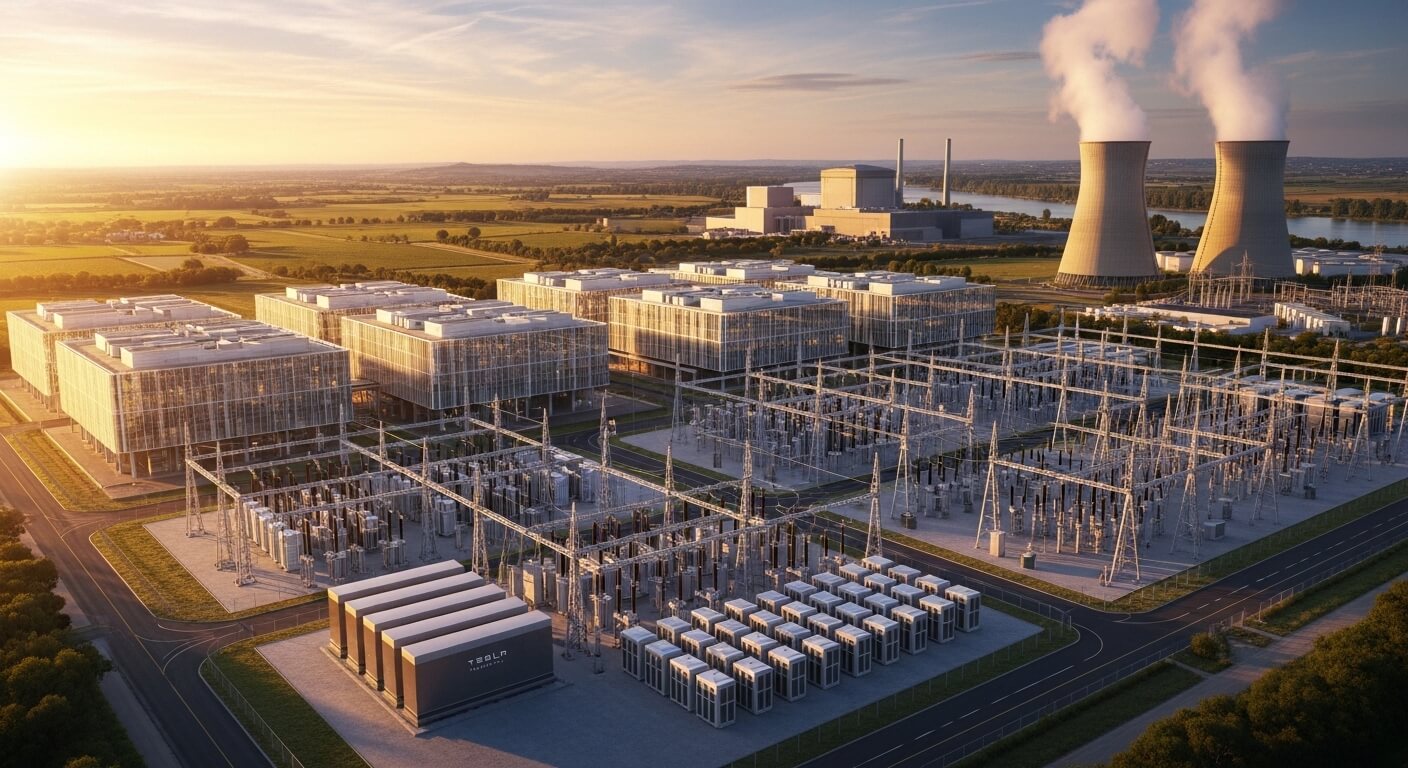
Black Hills Corp., an energy utility in South Dakota, has signed long-term agreements to serve Google’s planned data center in Cheyenne, Wyoming, establishing a power architecture that combines up to 590 MW of grid-connected service with approximately 2.1 GW of third-party resources managed through a private microgrid.
The agreements, effective September 30, run through 2048 and call for Black Hills to invest $1.8 billion between 2027 and 2029 in 564 MW of new company-owned natural gas generation. The data center is expected to begin taking power in late 2027 and ramp toward peak load in 2030.
The overall resource portfolio is expected to reach approximately 2.7 GW including reserve margins. Black Hills will provide up to 590 MW of grid-connected service using its own generation and market energy, while approximately 2.1 GW of Wyoming-based third-party contracted resources will be coordinated through a privately managed microgrid under the company’s Large Power Contract Service tariff.
New Generation — 564 MW natural gas generation owned by Black Hills affiliate
Third-Party Resources — ~2.1 GW of Wyoming-based contracted resources
Architecture — Privately managed microgrid + utility grid connection
The 564 MW of new gas generation will be constructed at Black Hills’ existing Cheyenne Prairie Generating Station and owned through a non-regulated affiliate. The remaining 26 MW required to provide the 590 MW grid-connected service will come from a combination of market purchases and retail utility service.
The arrangement also gives Black Hills a second revenue stream beyond generation. The company will receive microgrid management fees for coordinating grid operations, reliability services and energy dispatch across the contracted third-party resources and market purchases serving the Google facility.
Black Hills expects the project to contribute approximately $150 million in net income in 2030 and generate about $2.4 billion of unlevered free cash flow through 2048, net of the $1.8 billion generation investment.
The company said Google has already provided $399 million in refundable advances for procurement of long-lead-time generation equipment. Black Hills expects to reimburse those advances by June 30, 2027.
Customer Cost Protections
A central element of the agreements is the allocation of infrastructure costs. Black Hills says the structure is designed so Google bears all costs associated with serving the planned data center throughout the life of the project rather than shifting those costs to existing utility customers.
The agreements include cost pass-through mechanisms, full recovery of generation investment over the contract term, protections against stranded assets, early-termination provisions and collateral and financial-assurance requirements supporting Google’s long-term commitments.
The project will also require transmission infrastructure. Black Hills has already received approval for the Robinson substation, filed for expansion of the Cheyenne Prairie Generating Station and received an air-quality permit for that expansion. Additional South Cheyenne and Wyoming transmission projects are progressing through regulatory processes.
The Cheyenne agreement illustrates an increasingly important distinction in AI data-center power development: the utility connection and the total energy architecture are no longer necessarily the same thing. Black Hills is committing up to 590 MW of conventional grid-connected service, but the full resource portfolio is approximately 2.7 GW including reserves. The additional approximately 2.1 GW will come from contracted third-party resources coordinated through a private microgrid. That effectively makes Black Hills both a generation owner and an energy orchestrator for the campus.
The commercial structure is equally significant. Rapid AI infrastructure growth is forcing utilities and regulators to determine who bears the cost and stranded-asset risk associated with multi-hundred-megawatt and gigawatt-class loads. Black Hills explicitly structures the Google contracts around customer-funded economics, including recovery of generation investment, cost pass-throughs and termination protections. The approach resembles other emerging dedicated-generation models intended to add data-center capacity without transferring project-specific infrastructure costs to the broader rate base.
Google is pursuing several versions of this strategy simultaneously. Its recently announced agreement with Constellation supports 890 MW of incremental nuclear capacity in PJM, while its Texas developments with Intersect pair data centers with gigawatt-scale dedicated generation and storage. Cheyenne adds another model: a utility-managed hybrid architecture combining grid service, new natural-gas generation and a multi-gigawatt private microgrid.
The announcement also clarifies the evolution of the Cheyenne project. Black Hills previously described the opportunity as a prospective 1.8 GW data-center development without identifying the hyperscale customer. In June 2026, the utility confirmed that Crusoe was no longer the development partner but said it continued to work directly with the unnamed hyperscaler. The definitive agreements now identify that customer as Google and move the expected initial service date forward from early 2028 to late 2027.
Customers — 1.37 million natural gas and electric utility customers
Footprint — Eight U.S. states, including Wyoming
Strategic Role — Utility generation, grid service and private-microgrid resource management for Google’s planned Cheyenne hyperscale data center.
OCTOBER 6, 2026 · AI INFRASTRUCTURE Google, Constellation Sign Nuclear Deal to Add 890 MW to PJM Google’s parallel 20-year agreement supports 890 MW of additional nuclear generation through uprates to existing reactors.
JUNE 8, 2026 · AI INFRASTRUCTURE Google and Intersect Plan Texas Data Center with 1 GW+ Dedicated Energy The Meitner Energy Center pairs Google compute with wind, solar, storage and firming gas generation.
JULY 29, 2026 · AI INFRASTRUCTURE Former Paducah Enrichment Site to Become 1.2 GW Data Center Campus Another large AI campus uses dedicated generation and explicit protections against shifting infrastructure costs to utility customers.
SEPTEMBER 3, 2026 · DATA CENTERS Vertiv to Acquire UtilityInnovation Group for $1.45B The acquisition highlights the growing importance of microgrid controls, onsite generation and behind-the-meter architectures for AI campuses.
DECEMBER 23, 2025 · AI INFRASTRUCTURE Google’s $4.75B Intersect Deal Google’s acquisition of Intersect brought multi-gigawatt energy development capabilities closer to its data-center expansion program.
🌐 We’re tracking the infrastructure powering AI—from utility interconnections and dedicated generation to microgrids, energy storage and data-center power systems—on Converge Digest.