TechnologyUnited States
Oxide raises $445m to keep taking orders as demand for its on-premises cloud outruns its factory
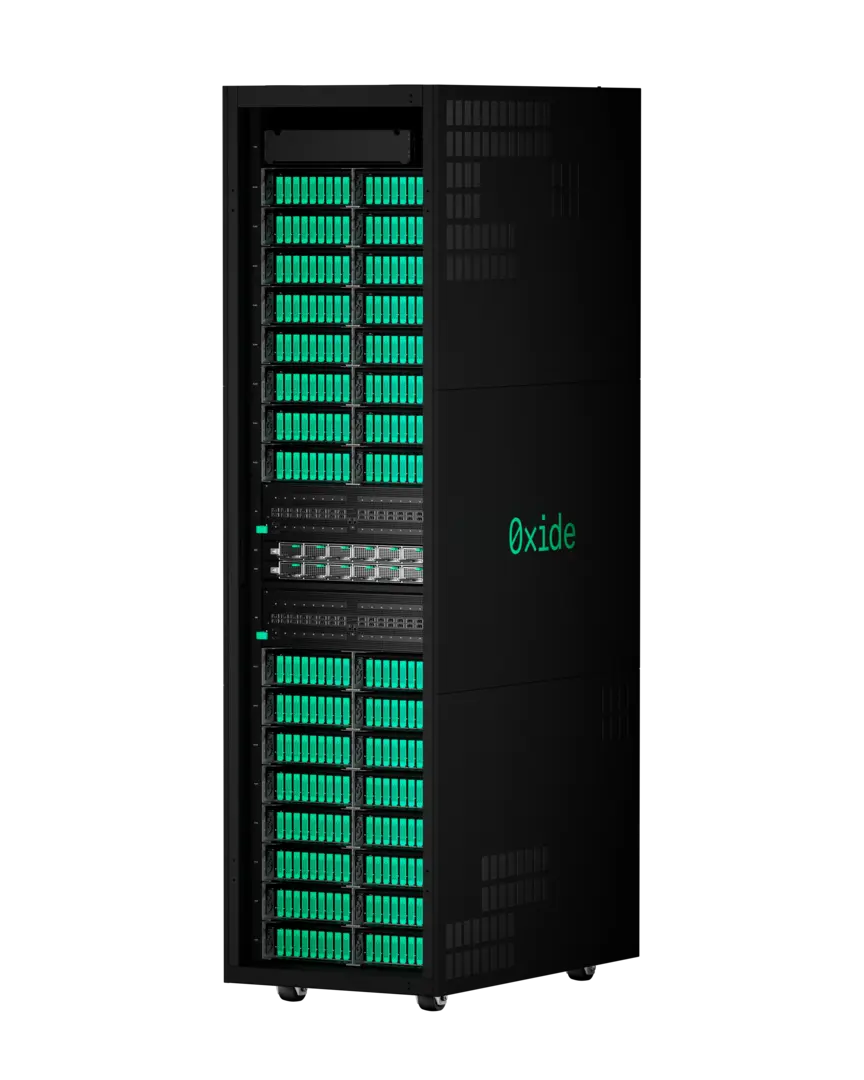
Oxide Computer Company, which builds rack-scale cloud computers that businesses run in their own data centers, has raised a $445m Series D led by Eclipse, the company said on Oct. 9.
Existing investors US Innovative Technology Fund, Riot Ventures and Jane Street took part, and Atreides Management and AMD Ventures joined as new investors. In a blog post, Oxide said Friends and Family Capital and Counterpart, both already shareholders, also joined. Oxide's announcement did not include a valuation.
The Emeryville, Calif., company said it became profitable earlier this year. It will use the money as working capital to secure components, increase manufacturing and serve customers, because customer demand exceeds its current production capacity.
"The accelerating pace of on-prem cloud computing projects has required us to scale manufacturing capacity by 20x over the past 12 months, and yet demand still exceeds supply," said Steve Tuck, Oxide's co-founder and chief executive. "We're well-capitalized, and hit an important profitability milestone earlier this year."
This is equity raised to fund inventory, not to cover losses. In its blog post, Oxide said its operations produced taxable income in the spring, and that it has "a very large order backlog." Because a hardware maker pays for parts and production long before systems ship, growth uses up cash. Oxide said its earlier rounds, existing debt facilities and its own cash flow would have covered the current backlog, but that it "would have had to exercise real caution in accepting additional demand." The Series D, it said, lets it "satisfy our substantial backlog while continuing to accept new demand."
The round is more than twice the size of Oxide's last. It raised a $100m Series B, then a $200m Series C led by Thomas Tull's US Innovative Technology Fund in February. Oxide said at the time that the Series C would "entirely de-risk" the company's capital.
The company's case is that AI agents are driving demand for general-purpose computing that companies own outright. "As AI shifts from generating answers to executing work, demand for CPU-based systems is accelerating dramatically," said Seth Winterroth, a partner at Eclipse. Bryan Cantrill, Oxide's co-founder and chief technology officer, said the company "certainly did not anticipate the explosion in compute demand from agentic AI" when it started in 2019.
The Oxide Cloud Computer is a single rack in which compute, storage, networking and open-source software are designed together. The pitch is cloud-style automation with direct control over security, performance, data and economics. Oxide says its customers include financial services firms, government agencies, national laboratories and aerospace companies.
Each compute sled in Oxide's current rack runs one AMD EPYC 9005 Series processor, according to Oxide's specifications, and a full rack holds up to 24 of them. "One of our first big bets was on AMD EPYC," Oxide wrote, calling AMD a new strategic investor.
"Oxide's systems-level approach to enterprise infrastructure is expanding the choices available to customers as their computing needs become more complex," said Sagi Paz, head of AMD Ventures.
For AMD, the stake ties it more closely to a customer whose demand comes from the kind of CPU-heavy work Eclipse describes. For Oxide, the next test is whether the new money turns its backlog into shipped racks.