CapitalUnited States
AI's builders are leaning on borrowed money. On Friday the market flinched.

Lenders ask one question before all others: can the borrower's cash pay what it owes? For the giants building AI, the standard answer is an easy yes. For the smaller companies renting out computing, it is already no, by our reckoning. And once capital spending is counted, even the giants look stretched. On October 16th the stockmarket traded as if it had done the sum.
The selling hit hardest among the companies that rent out AI computing on borrowed money. According to Nasdaq's closing data, CoreWeave closed at $61.39, down from $69.69 a day earlier, having already fallen from $77.81 to $65.78 on October 14th. Nebius closed at $165.47, down from $188.41; Applied Digital at $18.05, down from $20.39; IREN at $26.99, down from $30.39. Nvidia, which sells them their chips, slipped to $214.13 from $217.23. The PHLX Semiconductor index closed at 11,137.29, down from 11,581.22.
No filing explains the fall. None of those companies, nor Oracle or Meta, filed anything with the Securities and Exchange Commission on October 15th or 16th beyond insiders' share-trading forms, and no hyperscaler reported earnings this week. One data-center builder did file. Cipher Digital, formerly Cipher Mining, issued $850.0m of 0.00% convertible senior notes due November 1st 2032 on October 16th, with an option for $150m more, according to an 8-K that EDGAR accepted at 5:26pm Eastern time, after the close. Whether the deal and the fall are linked, the filing does not say.
So we ran the lenders' test. Debt-service coverage divides the cash a business generates by the principal and interest it must pay; below one times, it cannot meet its obligations from operations. We estimated it for four borrowers, from their filings and guidance: CoreWeave and Applied Digital, which rent out capacity, and Oracle and Alphabet, which buy it at scale. The numbers are ours, not the companies', and rest on assumptions set out below.
The standard test
Start with the renters. At June 30th CoreWeave had $35.6bn of total indebtedness, of which $3.7bn is non-recourse, according to its quarterly report. "Interest expense, net" was $640m in the second quarter, against $267m a year earlier. On its August 11th earnings call the company guided third-quarter interest expense to $860m–$940m, "reflecting the growth in our debt balance to finance our accelerating deployments," in the words of Nitin Agrawal, the chief financial officer.
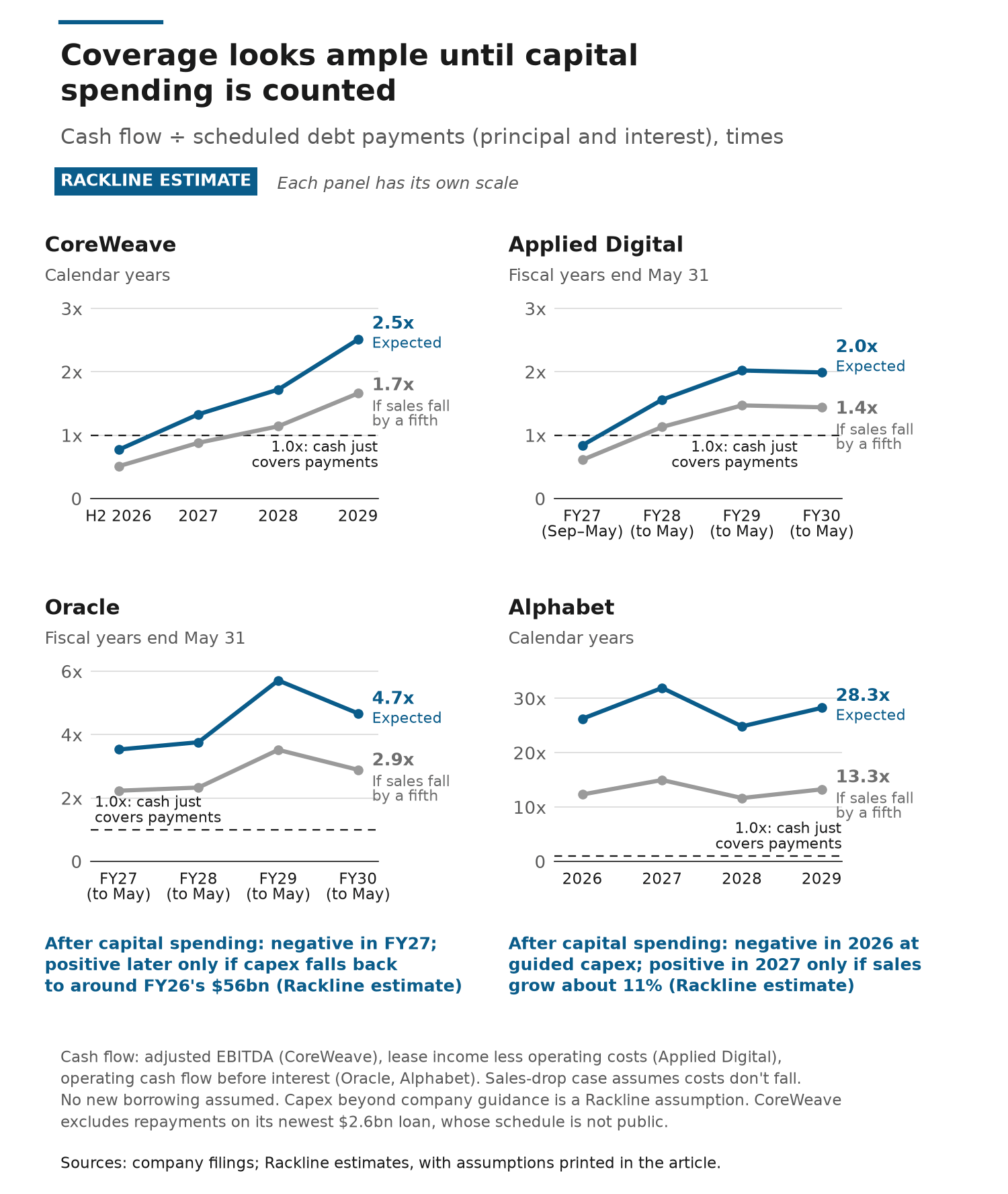
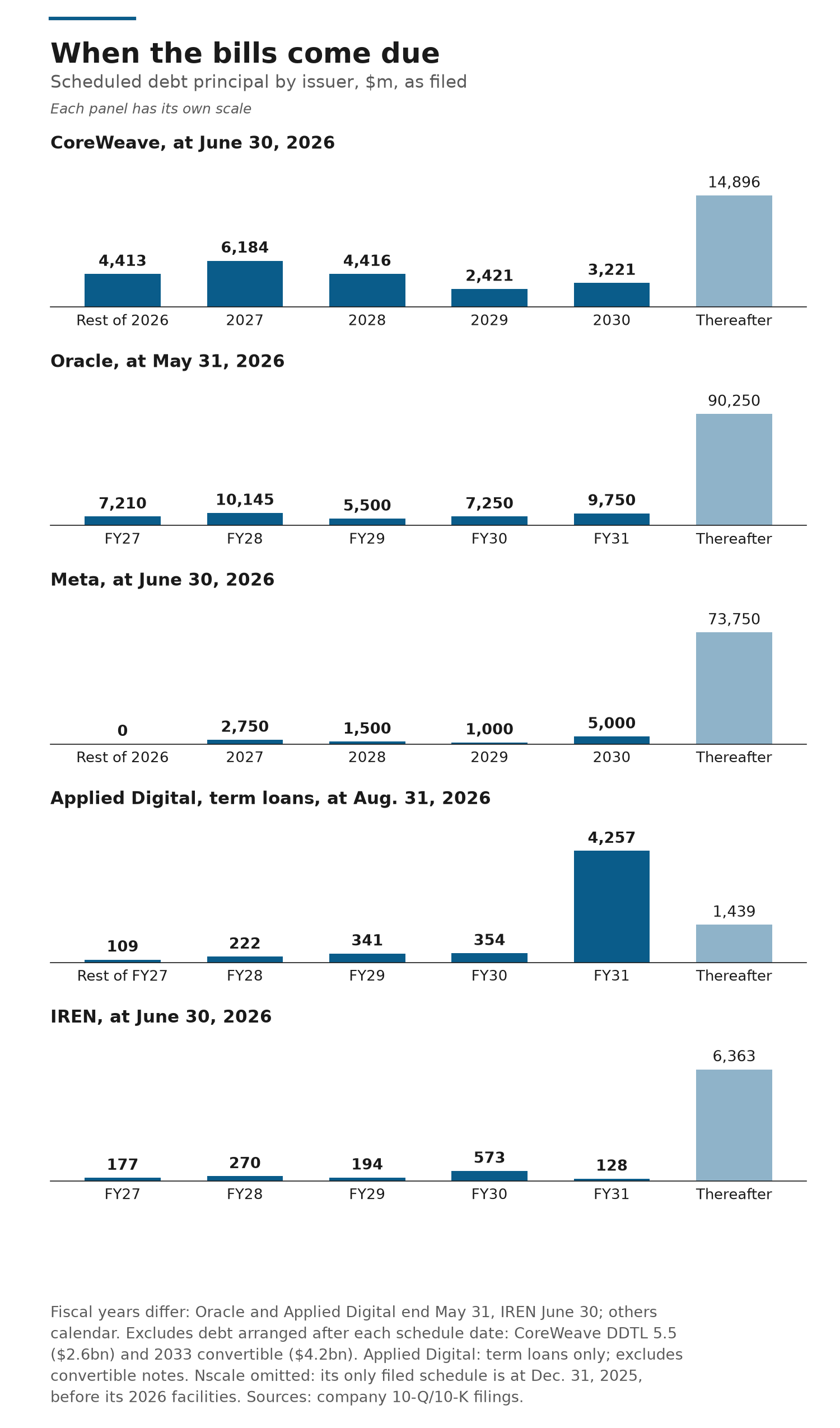
On those numbers, by our reckoning, CoreWeave's adjusted EBITDA covers only 0.77 times its debt service in the second half of 2026. To reach one times at its 59% margin it would need about $10.5bn of revenue in the half, against the roughly $7.7bn–$8.5bn its guidance implies. Its repayment schedule is front-loaded: the 10-Q shows $4.4bn of debt due in the rest of 2026 and $6.2bn in 2027, much of it amortizing equipment finance, including $4.2bn of recourse OEM and software-license financing that matures between December 2026 and July 2030 at an effective 11%. As those loans run off and contracted revenue arrives, its coverage climbs, on our estimates, to 2.51 times in 2029. That path assumes no new borrowing, which the company's own capex guidance makes unlikely. It also understates debt service from 2027, because the amortization schedule for its newest $2.6bn loan, signed in August, is not filed.
Applied Digital is below the line too. At August 31st, according to its 10-Q, $4.26bn of its $6.72bn of term-loan principal falls due in fiscal 2031, at a weighted-average rate of 7.3%; in the quarter to that date it earned $341.9m of revenue and lost $184.1m. The company does not file a margin on its leases. Working one out from its first-quarter rental figures gives about 73%, by our reckoning. On that basis its lease income covers about 0.84 times its debt service for the rest of fiscal 2027, or about 0.71 times after the segment's other costs. If every building opens on time, coverage rises to about 2.0 times by fiscal 2030, on our estimates.
The giants clear the standard test with room to spare. Oracle had $125.0bn of senior notes and other long-term borrowings outstanding at August 31st, according to its quarterly report. Interest expense was $1,428m in the quarter, up from $923m a year earlier, which the filing puts down mainly to new senior notes: Oracle sold $18bn in September 2025 and $25bn in February 2026, according to its 8-Ks. Its annual report showed that, at May 31st, $7.2bn was due in its fiscal 2027 and $10.1bn in fiscal 2028. Against that, by our reckoning, its operating cash flow covers debt service between about 3.5 and 5.7 times through fiscal 2030. Alphabet's debt is tiny beside its cash flow; on our estimates its coverage runs above 24 times in each year to 2029.
The renters are also more sensitive to revenue than to rates. Cut sales by a fifth and, by our reckoning, CoreWeave's coverage this half falls to between 0.51 and 0.62 times, depending on how much of its costs are fixed; Applied Digital's falls to 0.61–0.67 times on lease income. A rise of one percentage point in floating rates barely moves either ratio on the floating balances we can identify.
After the capex
The standard test has a hole in it. It leaves out capital spending, and for these companies capital spending is the business. None of them discloses how much of it merely maintains existing capacity, so there is no clean way to separate upkeep from growth. The honest alternative is to subtract all of it.
Do that for the hyperscalers and the picture changes. Alphabet guided 2026 capital spending to $195bn–$205bn on its July 22nd call, where its chief financial officer added: "we continue to expect our CapEx to increase significantly in 2027." By our reckoning, its operating cash flow falls short of capital spending in 2026 at any level within that range, before a dollar of debt is serviced. With capex held at that guidance, 2027 turns positive only if sales grow about 11% from 2026, by our reckoning. Its quarterly report shows how it is bridging it: in the six months to June 30th it issued $20.0bn of dollar notes and $31.8bn of notes in other currencies.
Oracle's gap is starker. Its fiscal 2026 free cash flow, as Oracle reports it, was negative $23,686m, and negative $5,396m in the first quarter of fiscal 2027, according to its earnings release. Its only guidance for this year's capital spending is that it will be "higher than fiscal 2026", when it spent $55.7bn. Holding it at the latest quarter's run-rate, Oracle's operating cash flow falls well short of capital spending in fiscal 2027, by our reckoning. Later years stay negative only if capex stays above about $60bn–$64bn a year; a fall back to around fiscal 2026's level would turn them positive. In the latest quarter it bridged the difference with $19.9bn from selling shares through an at-the-market program and $11.4bn of customer prepayments. For both giants, capital spending beyond what each has guided is our assumption, not theirs.
The renters' numbers already exclude capital spending, and still fall short this year. CoreWeave now guides full-year capex at $35bn–$39bn; its adjusted EBITDA, a non-GAAP measure it favors, was $1,510m in the second quarter, according to its earnings release.
Debt that does not look like debt
Then there are the obligations that never reach the balance sheet as borrowing. Oracle's 10-Q discloses $288bn of additional lease commitments, "substantially all related to data center arrangements," expected to begin between the second quarter of fiscal 2027 and fiscal 2029, for terms of 15 to 19 years. Add expected lease payments to Oracle's debt service, phasing those leases in as they start, and its coverage falls, by our reckoning, from about 2.5 times in fiscal 2027 to about 1.85 times in fiscal 2030. That still clears one. It is a long way from the comfort of the standard test, and it excludes capex.
Alphabet's 10-Q shows $85.2bn of leases not yet commenced at June 30th, starting between 2026 and 2031. Counting them still leaves its coverage above 12 times, on our estimates. The difference between the two is scale: Alphabet's lease pipeline is a fraction of its cash flow; Oracle's is not.
Meta has gone furthest down this road. Its quarterly report shows about $279bn of leases not yet commenced at June 30th, and describes a Louisiana data-center venture, entered into in October 2025, in which it holds a 20% interest and which it does not consolidate; it puts its maximum exposure to loss there at $46.03bn. In July Meta signed an exclusivity agreement for a second venture in El Paso, expected to close in the third quarter; on closing, Meta said in its quarterly report, it would provide residual value guarantees with a maximum exposure of about $13bn. No filing has yet confirmed a closing.
Smaller landlords lean on the giants' credit another way. TeraWulf's quarterly report says Google agreed to backstop certain obligations of Fluidstack, its AI-cloud tenant, under its leases, in return for warrants; Cipher's describes a similar arrangement at its Barber Lake site. None of this is improper. But it puts the build-out's leverage where a quick read of the balance sheet misses it: in leases not yet begun, in guarantees deemed improbable and in subsidiaries whose lenders can reach only one customer contract.
Revenue is what closes the gap, and it arrives slowly. CoreWeave says 41% of its $103.7bn of remaining performance obligations should be recognized in the 24 months to June 2028. Oracle's remaining performance obligations stand at $664bn, of which about 13% is expected to become revenue in the next 12 months and 37% in months 13 to 36, according to its 10-Q. Alphabet's quarterly report expects to recognize just over half of its $519.5bn revenue backlog at June 30th, $513.9bn of it Google Cloud's, within 24 months. CoreWeave reported 1.5 gigawatts of active power at June 30th, according to its 10-Q, and said on its call that it had about 4.2GW contracted as of August 11th. Backlog becomes cash only when power is energized and racks installed.
Our estimates rest on these assumptions, each company in its own fiscal years:
- CoreWeave: adjusted EBITDA as the company defines it; 2026 revenue at the midpoint of guidance, then the existing $103.7bn backlog spread over the periods the filing gives; second-quarter margin of 59% held; interest at about 8.5%, implied by guidance; no new borrowing or contracts; capex left out. - Applied Digital: rental income before depreciation; megawatts priced at one filed lease of $5.2bn over 15 years for 210MW; a lease margin of about 73%, by our reckoning from first-quarter rental figures, held, with a second version after the segment's overhead; head-office costs and capex left out; every building opens on time. - Oracle: operating cash flow plus interest; the $664bn order book as the only revenue, released as filed; fiscal 2026 cash margin held; capex at the latest quarter's run-rate; the $288bn of new leases phased in over 17 years. - Alphabet: operating cash flow plus interest; non-cloud revenue at twice the first half's; cloud revenue from the filed $513.9bn Google Cloud backlog; capex held at its $195bn–$205bn 2026 guidance in every year; the $85.2bn of new leases phased in through 2031.
Leaving out new borrowing flatters every figure.
Contained, but rising
 Open the interactive version
Our verdict: the strain is real but, for now, contained. It sits with a handful of renters. By our reckoning CoreWeave covers about 0.77 times its scheduled debt payments this half and Applied Digital about 0.84 times this fiscal year, so both depend on lenders to refinance or lend afresh. Oracle and Alphabet cover their debt easily; they are short of cash only because of the capex they choose to make. Oracle's annual report says as much: "for discretionary capital expenditures, the timing of such expenditures can be adjusted based on our liquidity position and access to additional financing." A renter with amortizing, contract-backed loans has no such dial.
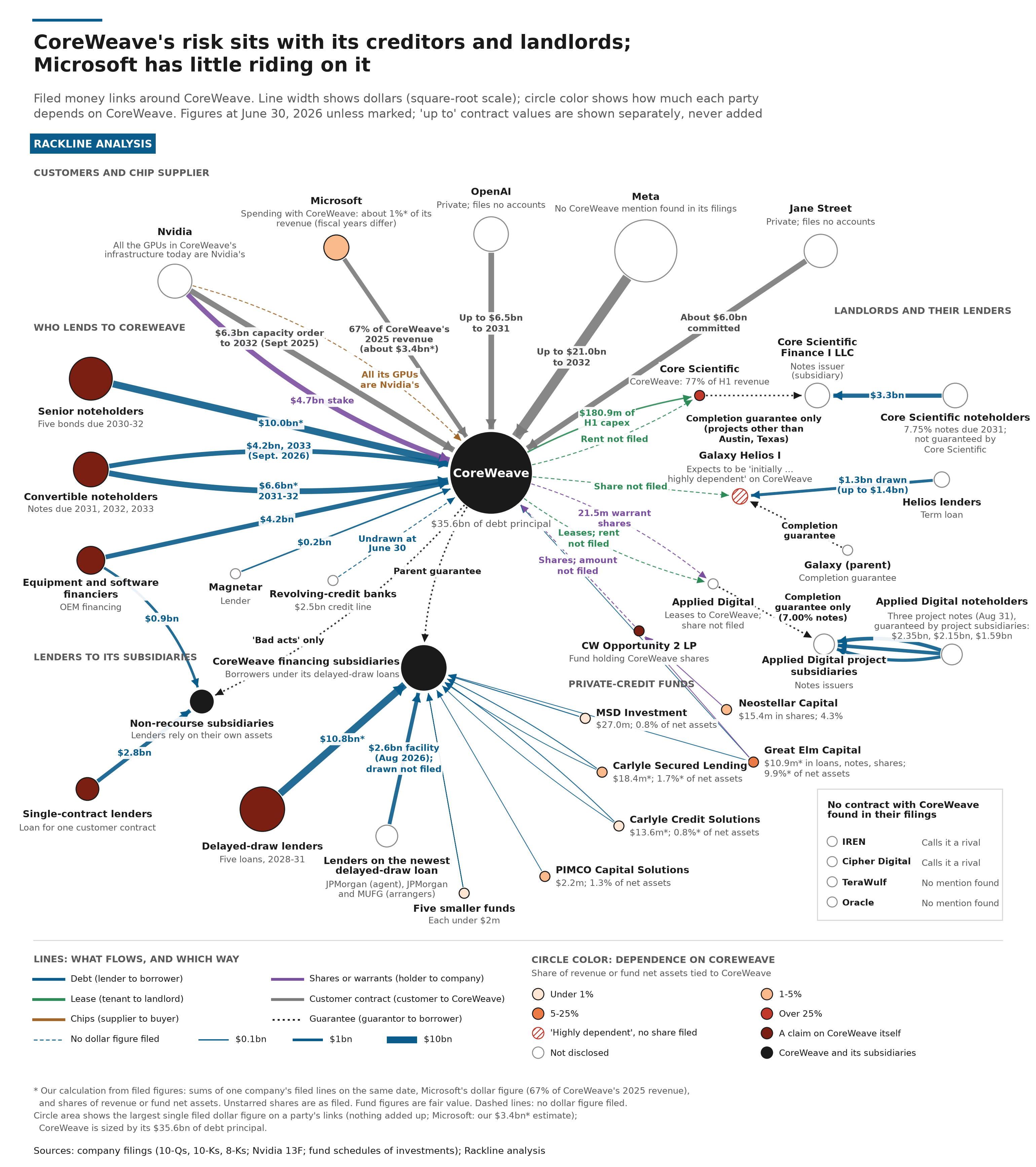
What could make it systemic is the plumbing. The renters lean on a few customers: CoreWeave's three largest provided about 36%, 26% and 10% of its second-quarter revenue, according to its 10-Q, and Applied Digital's largest provided 56% of revenue in the quarter to August 31st, according to its own. Money also moves in circles. Nvidia, whose chips are all of the GPUs in CoreWeave's infrastructure today, bought about $2.0bn of its shares in a private placement in January, according to CoreWeave's 10-Q; CoreWeave in turn holds warrants in Applied Digital, its landlord. The holders of most of this debt are not disclosed. And the giants' bonds are now a large slice of the market: hyperscalers' share of investment-grade corporate issuance has risen to "almost 10 percent" so far in 2026, "compared with just 0.5 percent in 2024", according to background analysis to the IMF's October Global Financial Stability Report.
Official bodies see the same mechanism, though none calls it a crisis. The Bank of England's Financial Policy Committee warned in September that "the increasing indebtedness of AI firms combined with opacity and, at times, 'circular arrangements' that can be associated with this financing, can complicate the assessment of risks and could amplify losses if expectations disappoint." The Federal Reserve's May Financial Stability Report found contacts worried that "capital expenditures are increasingly funded by debt, creating leverage in the system", though that comes from its survey of market contacts, not the Fed's own judgment.
Three signposts would mark the turn. First, a covenant waiver at CoreWeave, or new secured debt priced above 5.5 points over the secured overnight financing rate, the margin on its newest loan. A $8.5bn loan signed in March to finance a single customer contract, with no parent guarantee beyond "bad acts", pays 2.25 points over that benchmark on its floating-rate tranche, according to its 8-K. By our reading, lenders charge more where the parent stands behind the loan. Second, hyperscaler bond spreads widening by 50 basis points or more against the investment-grade index; that threshold is ours, but the IMF says their spreads have already widened "by about 30 basis points more than the broader IG index" since April. Third, Meta booking a liability on its residual value guarantees, which it now calls "not probable", or Alphabet or Oracle cutting capex guidance.
None has happened yet. Until one does, Friday's selloff is a repricing of a few leveraged renters, not the start of a credit crisis; the first test of that call is CoreWeave's third-quarter report, expected in November.