TechnologyUnited States
Arista Extends Ethernet With 144-XPU Scale-Up Architecture
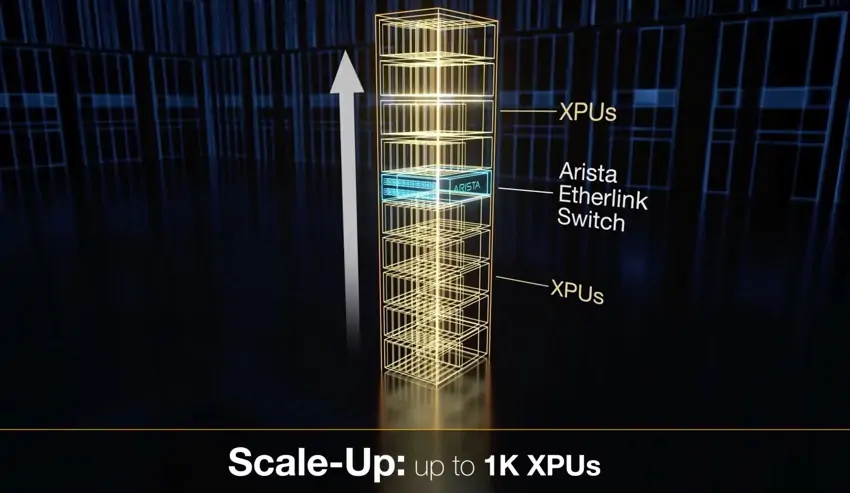
Arista Networks is pushing Ethernet deeper into the architecture of AI systems with new open rack-scale designs spanning Scale Up and Scale Out networking. Etherlink SU-144 is designed to connect as many as 144 XPUs within a single-hop rack and extend the Scale Up domain to as many as 1,024 XPUs through cross-rack configurations. Developed with ecosystem participation from AMD, Arm, Broadcom, d-Matrix, Meta, Microsoft and Qualcomm, the architecture builds on the Ethernet for Scale-up Networks initiative and expands Arista’s AI networking strategy into the compute rack itself.
The announcement fills in architectural details beyond Arista’s 7060XE7 introduction in June. Etherlink SU-144 defines how switching, accelerator connectivity, cooling, power and rack infrastructure can be assembled into an open Scale Up system. Arista proposes three physical implementations: an orthogonal chassis, a high-density cabled backplane, and a cross-rack design that separates the fabric from individual compute racks.
The orthogonal configuration is designed for racks operating in a 100 kW to 400 kW direct-liquid-cooling envelope. At these densities, network connectivity, power distribution, cooling manifolds, accelerator placement and signal reach become elements of the same system-level design.
Arista Etherlink SU-144: Key Architecture Points
Scale Up — Up to 144 XPUs in a single-hop rack-scale Ethernet domain.
Physical Designs — Orthogonal chassis, cabled backplane and modular cross-rack fabric.
Scale Out — Liquid-cooled 7060EX7 switches at 102.4 Tbps each.
Optical Roadmap — XPO and open CPO/NPO move projected rack optical capacity from 1.6 Pb/s toward 6.5 Pb/s.
On the Scale Out side, Arista is packaging multiple liquid-cooled 7060EX7 switches into rack-scale systems, with each switch providing 102.4 Tbps. The racks integrate fiber patch panels, cooling manifolds, active leak detection, rack-management controllers and power shelves with backup battery units. The Scale Out layer is designed to coexist with ESUN, NVIDIA NVLink and NVLink Fusion, as well as PCIe-based Scale Up systems.
Arista is tying the hardware to its broader AI fabric software architecture. The systems incorporate Ultra Ethernet Consortium technologies along with Multipath Reliable Connection, multi-plane routing, Dynamic Load Balancing and Cluster Load Balancing. Arista offers EOS while also supporting an open NOS on a common Netdi foundation.
Optics are another important part of the roadmap. Arista says current OSFP-based designs can provide approximately 1.6 Pb/s of connectivity per rack, while future XPO and open co-packaged or near-packaged optical architectures could raise this to approximately 6.5 Pb/s.
“The network in the AI era is no longer just an independent pipe between servers. It’s now a tightly integrated rack-scale backplane that is essential to maximizing compute,” said Tyson Lamoreaux, Senior Vice President, Cloud and AI Networking at Arista Networks.
The most important aspect of this announcement is Arista’s decision to move Ethernet directly into the Scale Up domain and package the network as part of the AI rack. Historically, Arista’s strongest position in AI infrastructure has been Scale Out. Scale Up requires extremely high bandwidth and low latency between accelerators participating in a tightly coupled compute domain.
Etherlink SU-144 provides a concrete indication of how Arista intends to address that opportunity. Rather than simply arguing that Ethernet can serve Scale Up traffic, Arista is defining physical rack architectures, cooling envelopes and cross-rack topologies around the concept. The 144-XPU single-hop configuration places Ethernet inside a domain that increasingly resembles a very large server backplane.
This clarifies why ESUN matters strategically. An open Ethernet Scale Up ecosystem would allow accelerator suppliers and hyperscalers developing custom silicon to build tightly coupled systems without requiring the entire compute and networking stack from a single vendor. Arista’s named ecosystem—AMD, Arm, Broadcom, d-Matrix, Meta, Microsoft and Qualcomm—illustrates the breadth of companies with an interest in more open accelerator connectivity. Arista is simultaneously preserving compatibility at the Scale Out layer with NVLink and NVLink Fusion systems.
The development also shows the convergence of compute, networking, optics, cooling and power engineering. A rack operating between 100 kW and 400 kW cannot be designed by treating those systems independently. Moving optical capacity from 1.6 Pb/s toward 6.5 Pb/s per rack also makes XPO, CPO and NPO architectural tools for increasing bandwidth density within power, space and thermal limits.
Core Platform — EOS, CloudVision and high-performance Ethernet switching/routing
AI Networking — Etherlink; Scale Up, Scale Out and Scale Across; 800G/1.6T; XPO; open CPO/NPO
🌐 We’re tracking the technologies reshaping AI infrastructure, including Scale Up, Scale Out, Scale Across, Ethernet fabrics, optics, switching, power and cooling. Follow ongoing coverage in Converge Digest’s AI Infrastructure section.