TechnologyUnited States
The AI factory gets a blueprint

In a convention hall in San Jose this week, the most consequential object on show was not a chip but a drawing of a steel cabinet. On Oct. 12, Nvidia said in its OCP summit announcement, it contributed the rack and compute-tray designs for its Vera Rubin systems to the Open Compute Project, an industry standards body, through version 1.2 of its MGX architecture. The specification supports racks drawing up to 250 kilowatts, fed by a liquid-cooled busbar rated at 5,000 amps.
A published rack gives makers of pumps, power shelves, switchgear and steel a fixed target, so they can tool up before a customer signs. With the standards open, Nvidia said, "manufacturers around the world have a common target to build for" and can deliver "without waiting for proprietary specifications from individual customers." Open specifications are turning the AI data center from a bespoke construction project into something closer to a manufactured, financeable product. That lowers the risk of building one, not of filling one. And as the factory becomes standard, the scarce inputs move outward, to grid connections, turbines and transformers, and upward, to whoever writes the reference design everybody else builds to.
Inside the open rack
Nvidia describes the Vera Rubin NVL72 as 72 Rubin GPUs and 36 Vera CPUs across 18 compute trays and nine NVLink switch trays: 1.3m components in a rack weighing roughly 4,000lb, "about the weight of a pickup truck." Redesigned trays, it says, cut assembly time from nearly two hours to five minutes. Supermicro's datasheet lists four 110kW power shelves per rack, but that is headroom, not draw; Nvidia has not published an operating wattage, so the 250kW ceiling is what facility engineers design to.
Nvidia claims up to ten times Blackwell's inference performance per watt and "one-tenth the token cost," vendor figures to be read as such. In its results for the quarter to July 26, it said Vera Rubin was "ramping into full production with racks running at partners including CoreWeave, Google Cloud, Microsoft Azure, Oracle Cloud Infrastructure and Nebius." Data-center revenue that quarter was $89.0bn, up 117% from a year earlier, and it guided to total revenue of $108.0bn, plus or minus 2%, for the current quarter.
Warmer water, bigger halls
Every MGX rack, Nvidia says, is designed for coolant entering at 45°C (113°F), warm enough for dry coolers rather than compressors in many climates. Nvidia says dry-cooler designs at 45°C can cut cooling water from about 2.6m gallons per megawatt a year for cooling-tower plants to near zero, with chillers needed perhaps 1% of the year in some climates, though Nvidia's DSX reference site still includes chillers, on their own 4.16kV supply.
The building is being specified too. AMD, Google, Meta and Nvidia also published version 0.7 of an Open Data Center Specification for 2027–28 builds. It sets rack height at 100 inches and weight at up to 8,000lb, twice the Vera Rubin rack, a cluster baseline of 12 megawatts minimum (24MW preferred) and a blended 25 kilowatts per foot of row, peaking at 350kW per foot in machine-learning zones. Floors, cranes and loading docks will be built to those numbers years before the chips that need them exist.
The 800-volt switch
Then there is electricity. Today's racks distribute power at about 54 volts DC, fed from 415-volt AC lines. At a megawatt per rack, Nvidia's engineers wrote, that would need up to 200kg of copper busbar, and power shelves alone would eat 64 units of rack height. Their answer is 800-volt DC, converting medium-voltage grid power once at the building edge. Nvidia says 800V busways carry 85% more power than 415V AC through the same conductor with 45% less copper, improve end-to-end efficiency by up to 5% and cut maintenance costs by up to 70%. Nvidia said in 2025 that full-scale 800V production would coincide with Kyber racks in 2027, targeting one-megawatt racks and "up to 30% total cost of ownership reduction." Nvidia's 2026 Vera Rubin POD blog says Kyber, a 144-GPU rack, will first ship with Vera Rubin Ultra and makes it the foundation for the Feynman era.
Upstream, Nvidia's DSX reference site steps utility power from above 100kV (230kV in the example) down to a 34.5kV backbone of switchgear rated 2,500A and 40kA, with four main lineups in N+1, separate buses for core network and GPU compute, and on-site generators (N+2) and batteries on the same bus. The bolder choice is what it leaves out: Nvidia's reference site keeps GPU compute off uninterruptible power supplies altogether. UPS covers only the core network racks and some mechanical plant; in an outage the GPU cooling plant leans on the thermal mass of the chilled-water loop until the generators start. That removes a large slab of capital cost, and shifts where the outage risk sits.
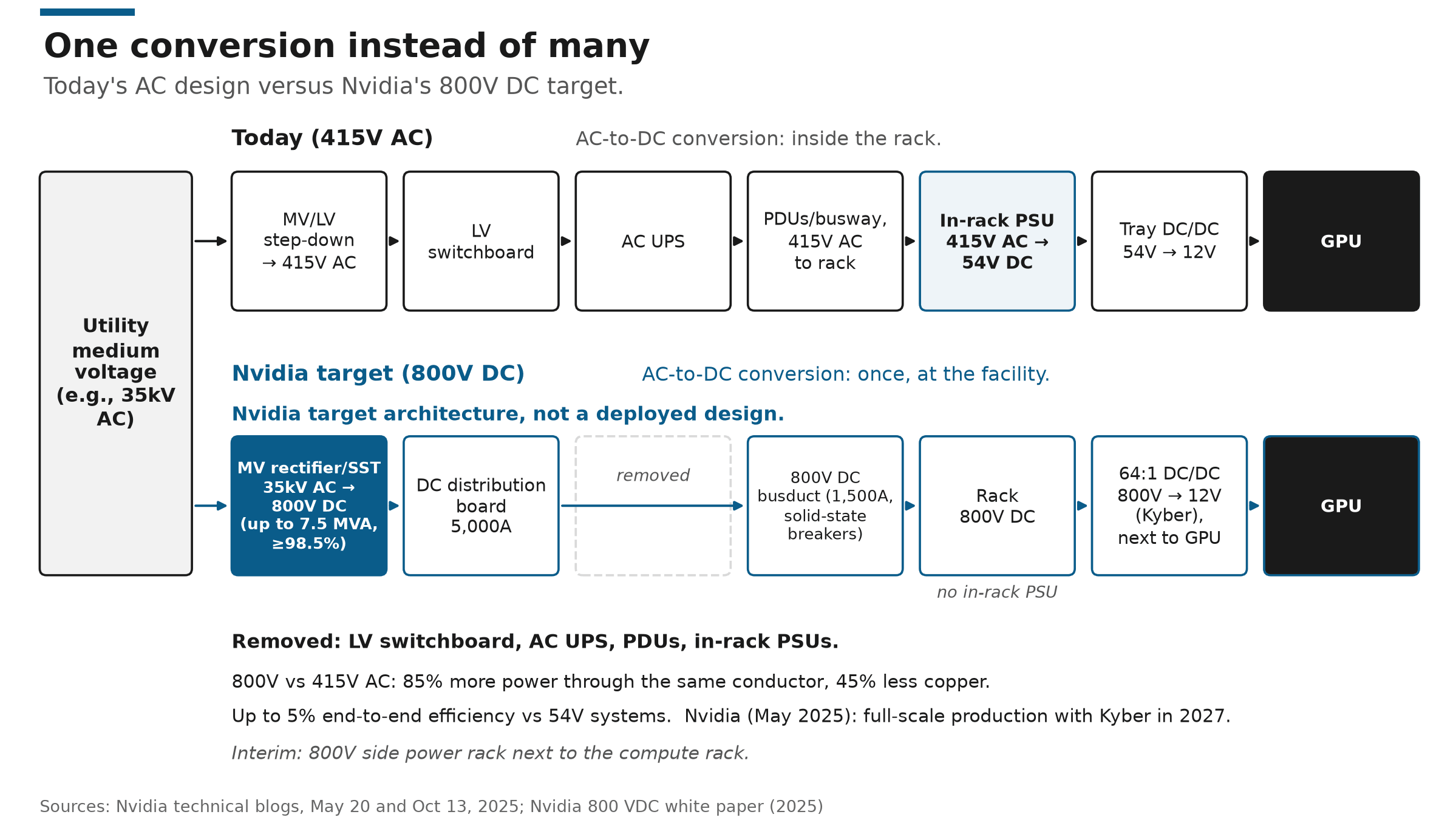
Nvidia cannot build that alone. Its 800V partners include Eaton, Schneider Electric, Siemens, Vertiv, ABB, GE Vernova, Hitachi Energy and Mitsubishi Electric. Vertiv said in October 2025 that its 800V DC portfolio would be released in the second half of 2026, timed for Rubin Ultra in 2027. The unglamorous risk is fault behavior. Vertiv's OCP session this week argues that because high-voltage DC lacks the natural zero-crossing that helps AC breakers interrupt current, protection must be addressed at the system architecture level. OCP's leaders write that standardized conversion to 800V DC, and eventually 1,500V, is still to be done, as are specifications for solid-state transformers that convert medium voltage straight to DC. Electricians, inspectors and insurers will need new rules.
Engineering firms are already turning specifications into floor plans. Schneider Electric's Reference Design 113, updated on Sept. 1, lays out a data hall of 10.4MW to 11.4MW for two Vera Rubin NVL72 clusters of 2,016 GPUs each, or 56 racks at roughly 227kW apiece, cooled by Motivair floor-mounted liquid-to-liquid units with fluid coolers. It accommodates both of Nvidia's operating points, MaxP and MaxQ, and says MaxQ gets "more tokens per watt." As projects reach gigawatt scale, says Bob Pragada, Jacobs's chief executive, "owners need greater certainty before committing capital."
That is the economic heart of the shift. A hall built to a published specification, with power and cooling validated by Schneider or Vertiv, is easier for banks and private-credit funds to value, re-let and underwrite than one designed around a single tenant's secret hardware—or so the underwriting case runs. In August Nvidia said it had agreed with Apollo, BlackRock, Blackstone, Brookfield, Goldman Sachs and KKR to set up compute-financing platforms intended to "mobilize over $500 billion of third-party capital" over time, subject to definitive agreements. Standard parts make standard collateral.
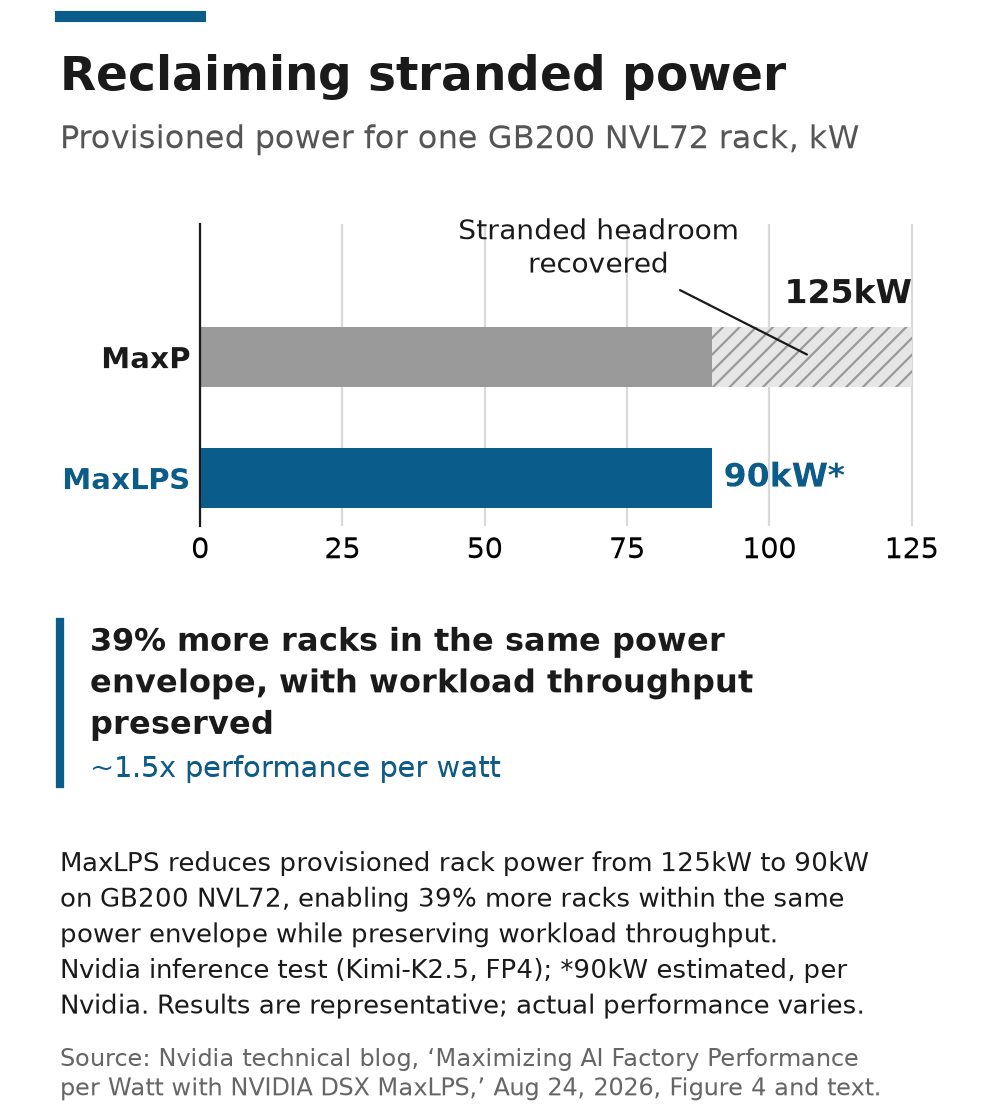
Software is being opened too. Nvidia's DSX platform, launched in Taipei on May 31, bundles reference designs, simulation and an operating layer, DSX OS, much of it open source. "Power is the limiting factor in an AI factory," says Warren Barkley, who runs DSX product management. Hence MaxLPS, which pairs 45°C cooling with Nvidia's Dynamic Power Software and, Nvidia says, can fit "up to 40% more GPUs" in the same site-power envelope. In an inference test on GB200 NVL72, Nvidia says MaxLPS cut provisioned rack power from 125kW to an estimated 90kW, enough for 39% more racks and about 1.5 times the performance per watt. The full gain requires a facility built for 45°C cooling from day one, and Nvidia notes that "Vera Rubin testing remains in progress."
Nvidia's illustrative 100MW factory shows where the power goes: 20MW to facility overhead, 10MW to losses in the racks and 10MW to failures, restarts and checkpointing, leaving 60MW for AI work. On Nvidia's numbers MaxLPS fits about 40,000 Rubin GPUs into a 100MW site; a smaller worked example puts 400 GPUs in a megawatt with 1.35 times the token throughput of MaxP, at a power-usage effectiveness (PUE) of 1.1, meaning facility overhead equal to 10% of the IT load. The Vera Rubin rack also carries 400 joules per GPU in capacitors, six times more on-board energy storage than prior generations, which Nvidia says cuts peak current demand by up to 25%. "You can simulate the entire factory before you spend a dollar," promises Jensen Huang, Nvidia's boss. No simulation can guarantee that a utility delivers the power on schedule.
A more flexible load
The same standardizing push now extends to how the factory behaves toward the grid. Under Nvidia's DSX Flex software, a grid-services company sends a signed, time-bound power target; the factory reports its power state by feed and can flag breaches. Nvidia cautions that "compliant" in Flex does not prove a utility program is being met. In September Google, Meta, Microsoft and Nvidia published an OCP specification committing large AI sites to ride through voltage dips and restore 90% of pre-fault computing load, typically 70–90% of a site's demand, within two seconds; the specification says its requirements "closely mirror" an ERCOT proposal. To qualify under DSX, batteries must smooth sudden AI load swings, following commanded ramps with a steady-state error of 2% or less, and must be able to black-start a dead bus. Vera Rubin's 400 joules of storage per GPU, Nvidia says, damps peak current.
That matters because grid connections are scarce. PJM, which runs much of the eastern American grid, forecast in January that its summer peak will reach 222,106MW by 2036, up 65,733MW over ten years. ERCOT's preliminary April materials showed large-load requests from non-crypto data centers in Texas rising from 7,401MW in 2026 to 228,420MW by 2032. Those are requests, not firm load, but at least one utility now offers faster connection to sites that can flex. Emerald AI says it has begun a commercial deployment of Nvidia's grid-response software with Silicon Valley Power, Santa Clara's municipal utility, under a program trading faster grid access for verifiable flexibility. In March Nscale signed a letter of intent with Microsoft for 1.35 gigawatts of Vera Rubin capacity at its Monarch campus in Mason County, West Virginia, delivered in tranches from late 2027 and powered by gas generators, enough for 2GW by the first half of 2028; Nscale says the campus will run "independently of the local grid."
The money is enormous. Alphabet raised its 2026 capital-spending guidance to $195bn–$205bn in July; Meta expects $130bn–$145bn including finance-lease principal; Microsoft expects roughly $175bn for calendar 2026 after reclassifying some leases; and Amazon said in February it expects to invest about $200bn. Oracle spent $28.5bn in the quarter to August alone. Federal Reserve staff estimate data-center investment reached about $370bn at an annualized rate by the second quarter, and Lisa Cook, a Fed governor, said on Sept. 28 that companies "have only spent a small fraction of the $2 trillion in announced plans." Nvidia lists eight cloud partners deploying parts of the DSX stack and more than 80 MGX ecosystem partners, by Nvidia's count. AMD is pursuing the same logic with Helion, an open rack blueprint built on its Helios system and based on an Open Compute Project spec-design.
Who sets the standard
Yet "open" has limits. The OCP specifications are published and anyone may build to them, and Nvidia's public DSX documentation runs to about 140 pages. But the sizing guide behind the MaxLPS numbers (NVOnline #1161311) and the Vera Rubin and GB300 reference designs need a partner login, and the performance claims that justify the economics are Nvidia's own. Building to one company's tempo brings speed and predictability; it also concentrates the power to set the next standard. If 800V DC arrives with Rubin Ultra in 2027, halls designed this year around 415-volt AC and 54-volt racks will need refitting, and the firm that draws the roadmap decides when.
Inference economics are what make all this worth doing. Nvidia's benchmark pages now report throughput per megawatt, putting Hopper (HGX H200) at 54,000 tokens per second per megawatt and Blackwell Ultra (GB300 NVL72) at 2.8 million, for low-latency agentic workloads, citing SemiAnalysis InferenceX. Its inference page puts GB300 at $0.12 per million tokens against Hopper's $4.20, about 35 times cheaper on those Nvidia figures, which Nvidia attributes to a third-party benchmark. Token consumption already exceeds 10 quadrillion a year, its Vera Rubin blog says. "Compute is revenue," Huang said in Nvidia's August results. If so, on a 1GW site Nvidia's claimed gain of up to 5% from 800V DC would free up to about 50MW, assuming the gain applies across the whole load. If not, a hall built to a common specification can be re-let or refitted; a bespoke one may stand empty. Open designs make AI factories cheaper to finance and quicker to fill. They do not create the customers.
Four tests lie ahead. First, whether Vera Rubin racks shipping in the second half of this year arrive in volume and run at the efficiency claimed. Second, whether Vertiv, Eaton, Schneider and Siemens deliver 800V DC protection gear that inspectors approve in time for 2027. Third, whether regulators in Texas and the PJM states turn flexibility and ride-through into a faster route to connection. Fourth, whether the $500bn of third-party capital Nvidia talks about moves from memorandum to signed agreements. If all go right, the AI factory of 2028 will look less like a hand-built cathedral than a container port: standard boxes, cranes and contracts, built wherever power can be found. The drawing unveiled in San Jose is a step in that direction. A standardized factory that can bend its demand to the grid's needs is one a utility may connect sooner, and live beside more easily.