TechnologyUnited States
Nvidia moves to set the rules for the batteries and cooling around its chips
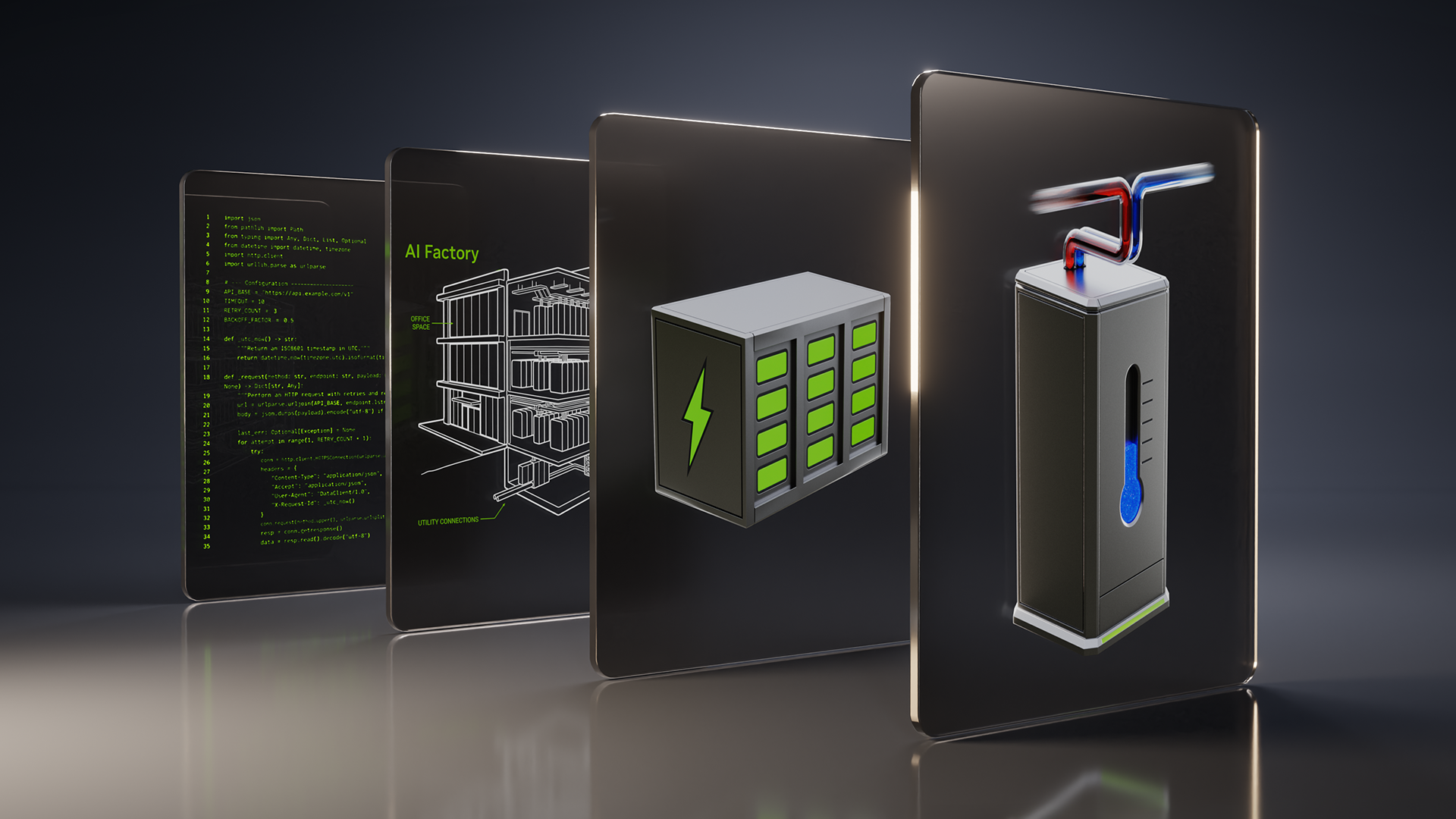
Nvidia does not sell battery systems or cooling plants. It is now telling the companies that do which of their products fit its AI data centers.
On Sept. 21 the chipmaker launched DSX Ready, a program that qualifies outside suppliers' equipment against the requirements of its DSX reference designs, the blueprints it publishes for what it calls AI factories. The first two categories are battery energy storage systems and coolant distribution units, which manage the flow and temperature of the liquid that carries heat away from densely packed chips. Nvidia said more categories "across infrastructure and software" will follow.
Nvidia lists Hitachi Energy, LG Energy Solution and Tesla as having qualified battery systems at launch, and LG Electronics, LiquidStack and Vertiv as having qualified cooling units. Of the six, Vertiv and LiquidStack, through its owner Trane Technologies, have confirmed their qualifications in their own announcements.
The reasoning is in Nvidia's description of the program. "Optimizing one part of an AI factory can shift the bottleneck elsewhere," the company wrote, adding that power, cooling, water, site and grid constraints "are shaping what builders can deploy." DSX Ready, it said, gives builders "a clear qualification to look for."
The two categories are qualified differently. Battery suppliers run Nvidia's required tests themselves and submit the data for Nvidia's review and approval. Cooling suppliers use a self-qualification test suite to show that a product meets Nvidia's functional requirements. Nvidia was careful about what the label means for batteries: passing "does not replace site-level engineering or imply site-level stability." Vertiv's release carries a similar caveat for cooling.
Suppliers moved quickly to advertise it. Vertiv said the same day that its 2.3 MW CoolChip coolant distribution unit was "the first CDU to qualify specifically as NVIDIA DSX Ready." On Sept. 28 Trane published two 250 MW cooling designs for AI factories "based on the NVIDIA DSX AI Factory platform." Both use LiquidStack's GigaModular unit, which Trane said had also qualified. Trane completed its purchase of LiquidStack in March.
Trane's figures show what is at stake for operators. One design pairs liquid cooling at the chip with air-cooled chillers; Trane said it "can reallocate up to 22 MW of power to compute." The other replaces an on-site central utility building with factory-built modular cooling plants, "reallocating 8 MW of electrical capacity to AI workloads," the company said. Trane said both designs consume no water. At a site where the grid connection caps how much power comes in, every megawatt that stops going to cooling can go to chips instead.
That is the economic logic Nvidia is pressing. At its Taipei conference in May it framed DSX as a way to get more computing out of each megawatt a site can secure. "We're not just shipping chips," Jensen Huang, its chief executive, said then.
Developers are signing on in public. IREN, the Nasdaq-listed AI cloud provider, said in May that it and Nvidia intend to support up to 5 gigawatts of DSX-aligned capacity across IREN's pipeline over time, with its 2 GW Sweetwater campus in Texas expected to be the flagship. IREN also gave Nvidia a five-year right to buy up to 30 million IREN shares at $70 each, or as much as $2.1bn. IREN's annual report says that right is subject to the delivery of up to 600,000 GPUs and to regulatory conditions, which ties Nvidia's equity to how much hardware IREN deploys.
Lancium, a Blackstone-backed developer based in The Woodlands, Texas, said in August that its campuses, 4 GW of leased capacity and a pipeline of more than 15 GW, would serve as deployment sites for Nvidia's platform, built using DSX reference designs. Lancium said Nvidia's DSX MaxLPS power technology would let it fit up to 40% more GPUs into the same power budget, and that a separate tool would let its campuses adjust their power draw to the grid. Nvidia also invested in Lancium. In South Korea, NAVER and Nvidia said in July that they plan to expand a DSX deployment at NAVER's Sejong data center from 55 MW to 200 MW by 2028. SK Telecom plans its first DSX-based AI factory for 2027.
Nvidia is also pushing the platform into software for the people who run these sites. On Oct. 7 it described DSX Air, a simulation of an AI factory that lets operators test configuration and software changes before they go live, including with AI agents that run the checks.
For suppliers, the program cuts both ways. A DSX Ready label could become a shortcut in procurement for developers building to Nvidia's designs. It also means a chip company is now writing technical requirements for grid-scale batteries and plant-room equipment, and deciding which products meet them. Nvidia has not said how many suppliers are waiting for qualification or when the next categories will open.
The next look comes soon. Nvidia is featuring DSX at its GTC conference in Berlin, Oct. 20 to 22. Investors in power and cooling suppliers will be watching for which categories Nvidia adds, whether more products clear the bar, and whether the developers that have signed on start naming the equipment going into their sites.